
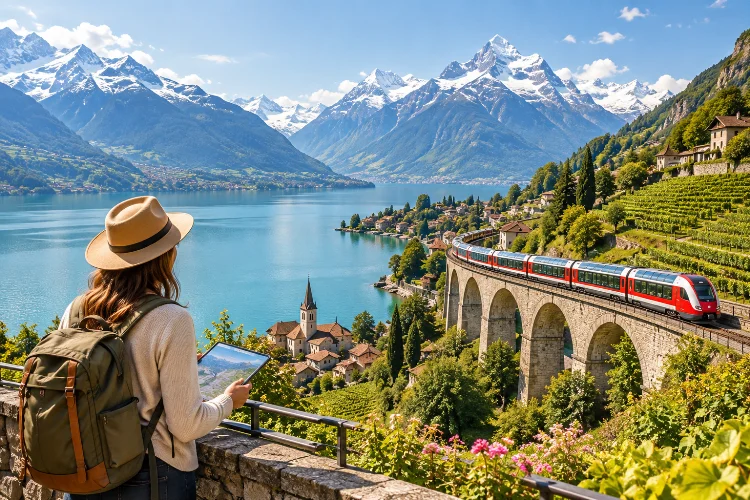
Switzerland and Austria are almost unfairly well suited to scenic travel.
Snow-covered mountains, turquoise lakes, vineyard terraces, dramatic railway viaducts, and compact Alpine towns can all appear within the same journey – and you rarely need to spend the entire trip behind the wheel.
The real challenge is deciding how to connect them. Trying to include every panoramic railway, famous mountain village, and postcard lake can quickly turn a relaxing Alpine adventure into an exhausting sequence of train changes.
Learning how to build scenic routes through Switzerland and Austria is therefore mostly about choosing a clear direction and letting transportation become part of the experience.
Switzerland excels at panoramic rail journeys, while Austria combines long-distance trains with mountain valleys, lake districts, and historic railway corridors.
A route such as Lucerne → Interlaken → Montreux → Zermatt → St. Moritz → Innsbruck → Salzburg → Vienna can create a natural west-to-east journey with surprisingly little backtracking.
The trick is knowing when to move—and when to stay.
Build the Trip in One General Direction
The simplest scenic itinerary usually follows one continuous geographic line.
Instead of traveling Zurich → Zermatt → Salzburg → St. Moritz → Vienna, reorganize the trip so each destination moves you closer to the next.
One possible route is:
Lucerne → Interlaken → Montreux → Zermatt → St. Moritz → Innsbruck → Salzburg → Vienna
This works because the western Swiss destinations gradually lead toward eastern Switzerland before the trip crosses into western Austria.
Open-jaw flights can make the strategy even better. Arrive through Zurich or Geneva and fly home from Vienna rather than returning to Switzerland.
You do not have to follow this exact sequence. The important principle is to avoid crossing the same Alpine territory repeatedly.
Draw your route on a map before booking hotels. If several lines overlap, there is probably a cleaner order.
Use Switzerland’s Panoramic Network Selectively
Switzerland makes scenic rail planning unusually easy.
Its official Grand Train Tour connects approximately 1,280 kilometers across eight sections, passing 11 major lakes and five UNESCO World Heritage Sites. The system combines famous routes such as the GoldenPass, Glacier Express, Bernina Express, and Gotthard Panorama Express.
You do not need to complete the entire circuit.
For a Switzerland-to-Austria journey, selecting two or three strong sections is usually more practical.
The Lucerne–Interlaken corridor provides lakes and mountain scenery without requiring an enormous travel day.
From Interlaken, continuing through Zweisimmen toward Montreux introduces the GoldenPass route and gradually shifts the landscape toward French-speaking Switzerland.
From Montreux, continue toward Zermatt if the Matterhorn is important to you.
Then the Glacier Express can carry you eastward toward St. Moritz. Switzerland Tourism lists the full Zermatt–St. Moritz section at roughly 7 hours 46 minutes.
That is a long train ride—but in this case, the train is the attraction.
Treat St. Moritz as the Bridge Toward Austria
St. Moritz works well as the final major Swiss mountain base before continuing toward Austria.
The area also connects naturally with the Bernina railway experience. Switzerland Tourism describes the Bernina Express as running through the UNESCO-listed Rhaetian Railway landscape, moving from glaciers toward southern terrain.
But if your next destination is Austria, you do not necessarily need to continue all the way south into Italy.
Instead, use St. Moritz as your eastern Swiss stop and begin moving toward the Austrian border through the Swiss rail network.
Austria and Switzerland are connected by frequent long-distance services. ÖBB currently lists multiple daily Railjet Xpress connections linking Austrian cities with Zurich, including services through Innsbruck and Vorarlberg.
This makes Innsbruck a logical next major base.
You are crossing countries without breaking the overall Alpine character of the trip.
Make Innsbruck and the Arlberg Part of the Journey
Innsbruck is much more than a place to change trains.
The city sits directly between mountain ranges, so you can combine urban sightseeing with Alpine excursions without changing hotels.
From Innsbruck, Austria Tourism notes that St. Anton am Arlberg can be reached by direct train in about one hour. The wider Arlberg corridor connects Innsbruck with western Austria through dramatic valleys and mountain scenery.
That gives you two choices.
Stay in Innsbruck and make St. Anton a day trip, or spend two nights in the Arlberg region if hiking, skiing, or higher mountain experiences are a major priority.
Avoid adding mountain resorts simply because they are famous.
Every hotel move costs time.
A three-night Innsbruck stay with one mountain excursion can feel much more relaxing than sleeping in three different Alpine villages on three consecutive nights.
And yes, the scenery will still be there tomorrow.
Slow Down Around Salzburg and the Salzkammergut
After several major railway journeys, the Salzburg region is an ideal place to reduce the pace.
ÖBB currently operates direct Railjet Xpress services between Innsbruck and Salzburg every hour.
Salzburg provides culture and architecture, while the nearby Salzkammergut introduces a completely different landscape of lakes, mountain peaks, villages, and historic transport.
Austria Tourism highlights the SchafbergBahn, which climbs to 1,783 meters in approximately 35 minutes, along with boat services connecting communities around Wolfgangsee.
This makes a strong city-and-nature combination.
Spend two nights in Salzburg, then add two or three nights around the lakes rather than attempting Hallstatt, St. Wolfgang, Bad Ischl, and Salzburg in one frantic day.
Hallstatt may be the famous name, but the region is much larger. The Salzkammergut includes multiple lakes, Alpine landscapes, historic salt heritage, and towns worth exploring beyond one viewpoint.
Slower travel definately works better here.
Add the Semmering Railway for a Historic Scenic Finale
If your itinerary continues east, do not assume the scenic part ends once you reach Vienna.
The Semmering Railway offers another style of mountain journey.
Built between 1848 and 1854, the 41-kilometer railway crosses high mountain terrain through tunnels and viaducts. UNESCO recognizes it as one of the pioneering achievements of early railway engineering and has listed it as a World Heritage Site since 1998.
Austria Tourism describes Vienna–Graz services via Semmering as a particularly scenic rail journey, taking roughly two and a half hours under normal scheduling.
That creates an excellent final extension:
Salzburg → Vienna → Semmering → Graz
Alternatively, stay overnight in the Semmering region before continuing south.
This section feels very different from Switzerland’s glamorous panoramic trains. The attraction is the combination of nineteenth-century engineering, forests, valleys, and viaducts.
It is a good reminder that scenic rail does not always require floor-to-ceiling windows.
Plan Around Seasons and Mountain Access
An itinerary that works beautifully in July may not work exactly the same way in November.
Switzerland’s major rail network operates year-round, but some scenic services, mountain railways, cable cars, lake boats, and Alpine roads follow seasonal schedules.
Austria has the same issue.
The SchafbergBahn and lake experiences around Salzkammergut are particularly appealing during warmer periods, while winter changes the region toward snow activities and ski travel.
Shoulder season requires the most attention.
A mountain railway might be closed for maintenance even though the main intercity train is running normally. Higher hiking trails may still be snowy in spring or already affected by early winter conditions in autumn.
Always check the exact operation dates of the experience you care about.
Do not book a hotel specifically for one cable car before confirming that the cable car is actually running.
It sounds obvious, but it is an incredably easy mistake to make.
Do Not Turn Every Travel Day Into a Panorama Marathon
The biggest danger with Switzerland and Austria is scenic overload.
If Monday is an eight-hour panoramic railway, Tuesday is another six-hour train, Wednesday is a mountain excursion, and Thursday involves three regional connections, you may eventually stop appreciating the scenery.
Add stationary days.
After the Glacier Express, spend at least one full day in St. Moritz. After reaching Innsbruck, avoid immediately leaving on another full-day excursion.
Also consider using normal trains on famous scenic routes.
In Switzerland, standard public-transport tickets can be valid across many sections of the Grand Train Tour, while special panoramic services may require additional reservations.
Switzerland Tourism specifically notes reservation requirements for services such as the Glacier Express and Bernina Express.
Regional trains can sometimes provide similar landscapes with more schedule flexiblity.
The “best” train is not always the most famous one.
Sometimes it is simply the departure that lets you sleep until 8:00.
Building a scenic route through Switzerland and Austria is not about collecting every famous railway or Alpine village.
The strongest itineraries move in one general direction, combine a few exceptional panoramic journeys with ordinary rail, and give important mountain regions enough time to breathe.
Use Switzerland’s panoramic network to move gradually east, cross naturally toward Innsbruck, slow down around Salzburg and the Salzkammergut, and consider the historic Semmering Railway as an Austrian finale.
Most importantly, schedule scenery with recovery time between major travel days.
Before booking, place your entire route on one map and identify the journeys that are experiences in themselves.
Then remove unnecessary backtracking and leave space for weather changes. A simpler route will usually give you better views – and much more time to enjoy them.
