
Northern Europe looks compact on a map, but planning a trip across Denmark, Sweden, Norway, Finland, Estonia, and nearby destinations can become surprisingly complex.
Long coastlines, islands, mountain ranges, ferry routes, and huge distances in the north mean that simply connecting capital cities is not always the smartest strategy.
That is where advanced Northern Europe travel for multi-country itineraries becomes useful.
Instead of building a trip around country count, you build it around transport corridors, realistic travel time, seasonal conditions, and places where changing from train to ferry or plane actually improves the journey.
A route through Copenhagen, Stockholm, Helsinki, Tallinn, and Oslo, for example, combines international rail with Baltic Sea crossings rather than depending entirely on flights. Add Norway’s fjords or Finnish Lapland, and the trip becomes even more varied.
The goal is not to move faster every day. It is to make each transfer support the overall experience while keeping enough time to enjoy the destinations themselves.
Build the Route in Geographic Sections
Start by dividing Northern Europe into logical travel zones.
Copenhagen and southern Sweden work naturally together because rail connections cross the Øresund region. Stockholm then functions as a useful gateway farther north and east. Helsinki and Tallinn form another compact pair across the Gulf of Finland.
A practical route could look like:
Copenhagen → Malmö → Stockholm → Helsinki → Tallinn
Norway can then become either the beginning or end of the itinerary, depending on your international flights.
This is generally more efficient than repeatedly crossing the region. An itinerary such as Copenhagen → Helsinki → Oslo → Tallinn → Stockholm may technically work, but it creates much larger geographic jumps.
Use open-jaw flights when possible. Arriving in Copenhagen and departing from Helsinki, Tallinn, or Oslo can remove the need to return to your starting point.
Use Rail Where It Has a Clear Advantage
Northern Europe’s railway network is particularly useful in Denmark and Sweden.
DSB currently describes Copenhagen–Stockholm journeys as taking a little over six hours, typically using the Øresund connection toward Malmö and onward high-speed rail toward Stockholm. It also lists more than ten possible daily connections under normal scheduling.
The Copenhagen–Malmö section is especially easy to integrate into an itinerary.
Øresundståg services connect Copenhagen with Malmö and continue along Swedish routes toward destinations such as Gothenburg. Operators advise checking live schedules because rail works can temporarily alter services.
That makes train travel useful when the journey itself moves you directly between city centers.
Do not automatically fly simply because two destinations are in different countries. Airport transfers and waiting time can make a short flight less convienient than a longer train journey.
Treat Ferries as Part of the Transport Network
One of the biggest mistakes in Northern Europe planning is thinking only in terms of rail and air.
The Baltic Sea is effectively another transportation corridor.
Helsinki and Tallinn are a perfect example. Tallink’s fast ferry services cover the crossing in about two hours, with multiple daily departures throughout the year and as many as six departures per direction on some schedules.
That makes Helsinki → Tallinn easy to include without adding another flight.
Ferries also connect Finland, Sweden, Estonia, and other Baltic destinations. Tallink’s network includes services linking cities such as Stockholm, Helsinki, Tallinn, Turku, and Åland.
Longer crossings can even function like night trains. You travel while sleeping instead of spending another full daytime period in transit.
Always check port locations, though. Ferry terminals are not necessarily beside central railway stations, so calculate the complete transfer rather than simply comparing sailing time.
Use Norway Differently From the Capital-City Circuit
Norway deserves a slightly different planning style.
If you visit only Oslo, treating it like another Nordic capital works fine. But Norway becomes much more rewarding when transportation itself is part of the sightseeing.
The Bergen Line between Oslo and Bergen is a strong example. Vy says the route takes roughly 6.5 to 7.5 hours and normally has around six to seven departures per day. The railway crosses the high mountain landscape of Hardangervidda along its 471-kilometer route
Seven hours may look inefficient compared with flying.
But that comparison misses the point. The railway journey is part of the experience.
For longer itineraries, consider giving Norway its own section: perhaps Oslo → Bergen followed by fjord travel, rather than trying to squeeze Norway between several two-night capital stays.
Add Nature Without Destroying the Route
Northern Europe becomes much more interesting when cities and landscapes are balanced.
Copenhagen, Stockholm, Helsinki, and Tallinn can create a strong urban backbone. Then add one or two longer nature-focused sections instead of taking endless small detours.
Finland provides a good example.
VR operates night trains from southern Finland toward Rovaniemi, Kolari, and Kemijärvi, making Lapland accessible without sacrificing an entire daytime travel period.
That means a traveler could explore Helsinki, take a night train north, spend several days in Lapland, and return south before continuing toward Estonia or Sweden.
The same principle works elsewhere. Use a major city as an access hub, spend several nights in the surrounding region, then continue forward.
Avoid adding distant landscapes simply because they look spectacular online. A destination requiring two flights and three accomodation changes may reduce the quality of the entire itinerary.
Plan Around Seasonal Light and Weather
Season matters much more in Northern Europe than many first-time visitors expect.
Summer offers extremely long daylight hours, particularly as you move north. That can make sightseeing, hiking, ferry travel, and evening exploration unusually flexible.
Winter creates the opposite experience.
Days become shorter, especially in northern Scandinavia and Finland, so sightseeing schedules need more structure. However, winter also opens the door to snow-focused travel, northern landscapes, Christmas-season experiences, and aurora trips.
Shoulder seasons require flexibility. Weather can shift quickly, and some regional services operate differently outside peak travel periods.
Build some breathing room into nature-heavy itineraries. Do not schedule your only important outdoor experience during a tiny four-hour window before your next train.
Seasonal travel works best when the itinerary adapts to nature rather than pretending every month operates like July.
Balance High Costs With Slower Travel
Northern Europe has a reputation for being expensive, particularly in major Nordic capitals.
One useful response is not necessarily choosing cheaper destinations – it is reducing the number of transfers.
Every city change can generate another station transfer, luggage locker, ferry meal, airport journey, or last-minute purchase.
Staying four nights instead of two can sometimes reduce your average daily transport spending.
A route combining Nordic capitals with Baltic cities can also help balance the budget. Tallinn, for example, may create a different spending pattern from Copenhagen or Oslo while still fitting naturally into a Helsinki-centered itinerary.
Book expensive long-distance sections early when your dates are fixed, but preserve flexiblity for shorter local journeys.
Think in terms of total trip economics rather than simply hunting for the cheapest hotel each night.
Understand Schengen Rules Before Building a Long Trip
Most popular Nordic and Baltic destinations used in these itineraries are within the Schengen Area, including Denmark, Sweden, Norway, Finland, Estonia, and Iceland.
The Schengen Area currently contains 29 countries. For travelers subject to the standard short-stay rule, stays are generally limited to a maximum of 90 days within any rolling 180-day period; exact visa requirements still depend on nationality
Another important change is the Entry/Exit System.
The EU’s EES has been fully operational since 10 April 2026. It digitally records relevant short-stay non-EU travelers crossing external Schengen borders, including travel-document and biometric information.
This does not mean you encounter an external immigration process every time you travel between two Schengen countries. But travelers entering or leaving the area should understand the current border procedures.
Check the official rules for your passport before departure rather than relying on an old travel blog.
Build Buffer Days Into Longer Itineraries
Complex trips eventually encounter something unexpected.
A railway timetable changes. Weather affects a ferry. You discover Stockholm deserves another day. Or you simply become tired of moving every 48 hours.
Leave space for that.
After two or three faster stops, schedule a four-night stay somewhere. Stockholm, Copenhagen, Helsinki, Bergen, or another major hub can function as a reset point.
Operators themselves recommend rechecking transportation schedules because infrastructure work can affect services.
Øresundståg warns that timetable adjustments may occur because of rail works, while VR publishes planned Finnish track-work changes that can include replacement buses or altered night-train operation.
A good itinerary is not one where every minute is occupied.
It is one that can survive a change without the entire trip falling apart.
Advanced multi-country travel in Northern Europe works best when you stop treating every border crossing as a separate vacation.
Build geographic sections, use trains between well-connected cities, include ferries across the Baltic, and reserve flights for jumps where they genuinely save meaningful time.
Give Norway and northern Finland enough space to function as experiences rather than rushed detours. Consider seasonal daylight, transportation changes, border requirements, and the hidden cost of constantly changing hotels.
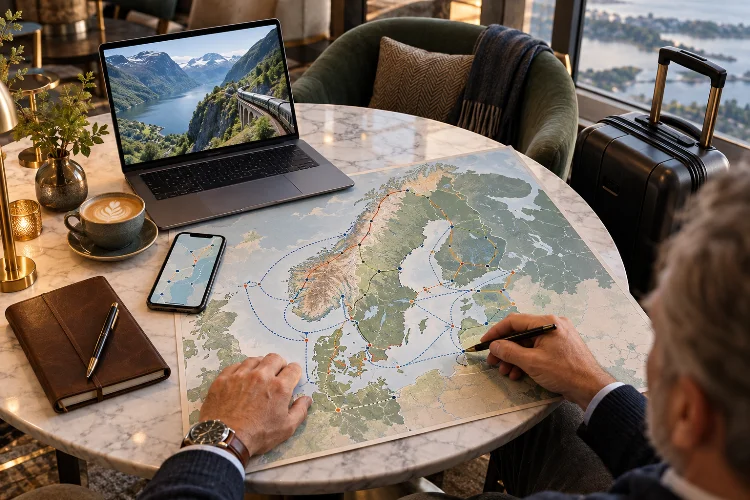
Before booking, put every destination on one map and label each transfer as rail, ferry, flight, or overnight journey. Then remove anything that creates unnecessary backtracking.
A slightly shorter destination list usually produces a richer trip – and gives you much more time to actually experience Northern Europe.
