
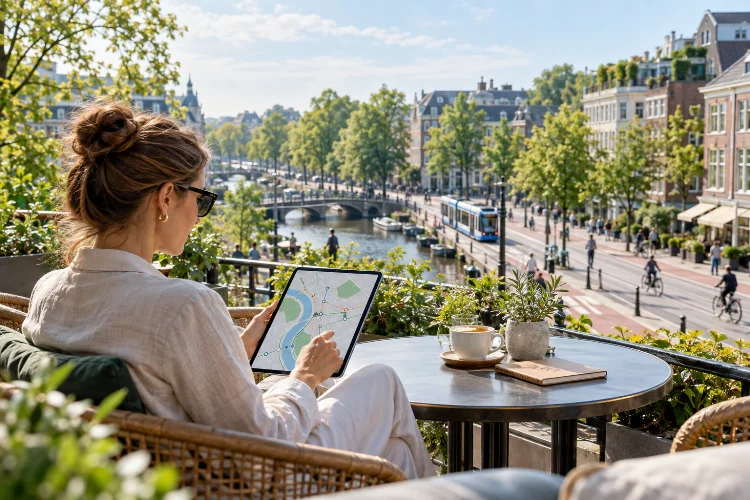
Choosing between European cities often starts with the obvious questions. Which one has the most famous museums? Where can you see iconic architecture? Which destination has the longest list of landmarks?
Those questions matter, but they rarely tell you what spending three, five, or seven days in a city will actually feel like.
Learning how to compare European cities beyond traditional attractions means looking at everyday factors such as public transport, walkability, local neighborhoods, green spaces, affordability, accessibility, crowds, and the overall pace of life.
Paris and Vienna may both offer world-class cultural attractions, for example, while providing very different daily experiences.
This broader approach is especially useful when planning longer European trips. Once you have already visited several cathedrals, museums, and historic squares, details like an easy metro system or a quiet neighborhood café can become surprisingly important.
The best European city for your trip is not necessarily the city with the longest sightseeing checklist. Sometimes it is simply the place where everyday travel feels easier.
Compare How Easy It Is to Move Around
Start with mobility.
A destination may have dozens of attractions, but your experience changes considerably if reaching them requires complicated transfers or long taxi rides.
Look at the city’s metro, tram, bus, suburban rail, cycling infrastructure, and pedestrian network. More importantly, consider how these systems connect the neighborhoods where travelers actually stay.
The European Commission treats accessibility, public transport, active mobility, safety, congestion, and sustainability as major elements of urban mobility.
Its current framework also covers 431 designated urban nodes where mobility planning is becoming increasingly standardized.
For travelers, the lesson is simple: don’t compare cities only by the number of attractions. Compare how easily you can move between them.
Amsterdam may appeal to someone who enjoys cycling and compact neighborhoods, while Berlin’s extensive transport network can make a geographically larger city easier to explore than its size suggests.
A slightly less famous destination with convinient transportation can ultimately produce a much smoother vacation.
Look at Everyday Quality of Life
Tourists temporarily participate in city life too.
You use sidewalks, parks, trains, public squares, cafés, supermarkets, and local services just like residents do. That makes quality-of-life indicators surprisingly useful when comparing travel destinations.
The European Commission’s 2023 Quality of Life in European Cities survey covered 83 cities.
Almost nine out of ten respondents reported being satisfied with living in their city, but the study also found meaningful differences involving public transport, green spaces, cleanliness, noise, safety, housing, and public services.
These factors can help you move beyond the usual “Rome versus Paris” comparison.
Ask what kind of daily environment you prefer. Some travelers love enormous, energetic capitals that remain busy late into the evening. Others enjoy smaller cities where walking between neighborhoods feels easier and quiet public spaces are never far away.
Neither experience is automatically better. They simply fit different travel styles.
Compare Neighborhoods, Not Just City Centers
A city center is not the entire city.
Popular travel guides naturally concentrate on historic districts because that is where major monuments tend to be located. However, your favorite part of a trip may end up being a residential area several metro stops away.
When researching destinations, investigate at least three types of areas: the historic core, an everyday residential district, and a neighborhood known for food, creative culture, or nightlife.
This gives you a much better picture of the destination’s personality.
For example, two cities may both have impressive medieval centers, but one may become very quiet after dinner while the other has lively neigbourhood restaurants and public spaces well into the evening.
Google Maps, local tourism websites, public transport maps, restaurant opening hours, and walking routes can reveal these differences before you arrive.
A useful question is: What would I do here after finishing the famous attractions?
If the answer still sounds interesting, the city probably deserves more time.
Think About Crowds and Tourism Pressure
Popularity has a cost.
Europe recorded nearly 3.1 billion nights in tourist accommodation in 2025, another record year for EU tourism. International guest nights also continued increasing.
At city level, Eurostat data on short-stay accommodation booked through online platforms show particularly strong tourism volumes in destinations such as Paris, Rome, Barcelona, Lisbon, Madrid, and Milan.
High visitor numbers do not mean you should avoid popular destinations. They simply mean crowd levels should become part of the comparison.
Consider traveling in April instead of July, staying outside the most visited district, or visiting major sights early in the morning.
You can also compare famous capitals with smaller alternatives. Instead of automatically adding another major city, a longer itinerary might become more interesting with places such as Bologna, Ghent, Ljubljana, Salzburg, or Porto.
Traditional attraction counts tell you what exists. Tourism intensity helps tell you what experiencing it may actually feel like.
Include Green Space and Environmental Comfort
Air quality and access to outdoor areas rarely appear at the top of a first-time travel checklist.
After several days of walking through dense urban neighborhoods, however, parks, waterfronts, trees, cleaner air, and quieter streets can make a big difference.
The European Environment Agency currently provides an air-quality comparison covering 761 European cities. Its methodology considers population exposure and health risks associated with PM2.5, nitrogen dioxide, and ground-level ozone.
You do not need to turn vacation planning into environmental research, but these indicators can help when deciding between destinations for longer stays.
Also inspect parks and waterfront access on a map. Vienna’s green spaces, Copenhagen’s waterfront environment, Madrid’s large parks, or Ljubljana’s compact pedestrian areas may add value that is difficult to capture through lists of monuments.
This becomes especially relevant for families, runners, slower travelers, and anyone spending one or two weeks in the same city.
Compare Accessibility for Your Actual Needs
Accessibility means different things for different travelers.
Someone using a wheelchair may need step-free public transportation and accessible accommodation. Parents may care about elevators and stroller-friendly sidewalks. Travelers carrying large luggage may simply want a railway station that is easy to reach.
The EU’s Access City Award highlights cities working to improve accessibility across transport, public spaces, buildings, services, culture, and tourism. Previous recognized cities have included Hamburg, Ljubljana, Córdoba, Grenoble, and others.
Before choosing between destinations, think realistically about your group.
A charming hilltop district with cobbled streets might look beautiful in photographs but become exhausting for someone with limited mobility. An efficient tram network could be more valuable than another famous landmark.
Accessibility is not a minor technical detail. It directly shapes how much of a destination you can comfortably enjoy.
Judge Cost by Experience, Not Only Hotel Prices
Comparing two cities by hotel price alone can be misleading.
A cheaper hotel far outside the center may create additional transport costs and consume more time. Meanwhile, a more expensive room in a walkable district could reduce daily transportation expenses.
Think about the whole travel day: accomodation, breakfast, local transportation, attractions, casual meals, coffee, nightlife, and airport transfers.
Housing and urban costs across Europe have also changed considerably in recent years. Eurostat reported that EU households spent an average of 19% of disposable income on housing in 2024, while both house prices and rents had risen substantially compared with 2010.
Resident housing costs are not the same as tourist prices, of course, but they remind us that “cheap Europe” and “expensive Europe” are increasingly complicated categories.
Compare value instead.
If City A costs €30 more per day but gives you better transportation, easier walking, more free public spaces, and activities you genuinely enjoy, it may still offer the better experiance.
Build a Personal City Scorecard
There is no universal ranking that can decide which European city is right for everyone.
Instead, create a simple personal scorecard.
Choose the factors that matter to you
Give each destination a score for mobility, walkability, food, nightlife, museums, green space, crowd levels, budget, accessibility, day-trip potential, and neighborhood atmosphere.
Then weight the categories.
A food-focused traveler might give restaurants and markets twice the importance of museums. Someone traveling with children might prioritize parks, public transportation, safety, and shorter walking distances.
This method prevents famous landmarks from automatically dominating the decision.
You might discover that a lesser-known city matches your travel style far better than a destination appearing on every “Top 10 Europe” list.
That is exactly the point.
Comparing European cities becomes much more useful when you look beyond monuments, museums, and postcard views.
Transportation, neighborhoods, green space, environmental comfort, accessibility, tourism pressure, everyday costs, and local atmosphere often determine whether you genuinely enjoy spending time somewhere.
Use famous attractions as one part of the decision rather than the entire decision.
Before choosing your next destination, imagine an ordinary day there. Where would you have breakfast? Could you walk around comfortably? How would you reach another neighborhood? Where would you relax in the afternoon?
Build a simple city scorecard around the experiences that matter most to you. You may discover that the perfect European destination is not the one with the most attractions, but the one that best fits how you actually like to travel.
