
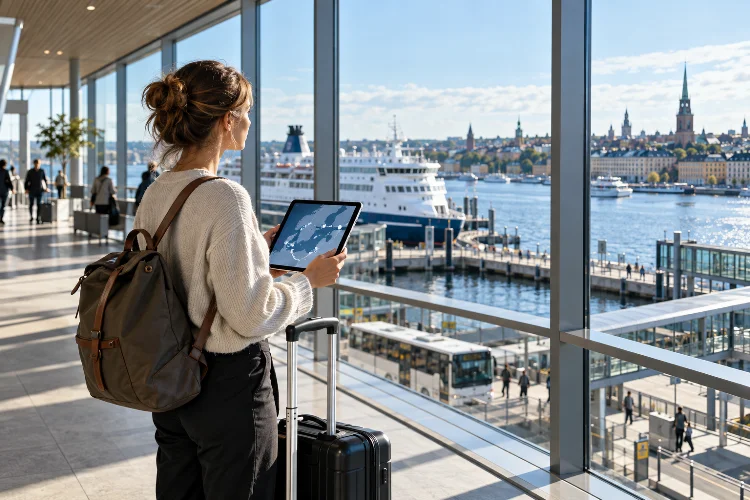
Planning a journey across Scandinavia and the Baltic countries looks straightforward until you notice how much water sits between the destinations.
Copenhagen, Stockholm, Helsinki, Tallinn, Riga, and Vilnius form an attractive multi-country route, but connecting them efficiently requires more than drawing a straight line on a map.
The good news is that this region offers an unusually interesting mix of transportation.
High-speed and intercity trains handle much of Scandinavia, overnight ferries cross the Baltic Sea, fast ships connect Finland and Estonia, and improving rail and coach links make the Baltic capitals increasingly accessible.
Learning how to build efficient routes across Scandinavia and the Baltics therefore means choosing the right transport mode for each section rather than forcing the entire journey onto trains or planes.
A well-designed route can turn transportation into part of the experience. The key is moving in one direction, limiting backtracking, and treating the Baltic Sea as a travel corridor rather than an obstacle.
Start With a One-Way Geographic Route
The simplest strategy is to build the trip from west to east or east to west.
A strong example is:
Copenhagen → Malmö → Stockholm → Helsinki → Tallinn → Riga → Vilnius
This sequence keeps you moving forward and combines several transport systems naturally. Copenhagen and Malmö are connected through the Øresund rail corridor, Stockholm becomes the major Swedish hub, and ferries provide the bridge toward Finland and Estonia.
Öresundståg’s 2026 network continues to link Copenhagen with Malmö and destinations farther into southern Sweden.
Try to avoid an itinerary such as Copenhagen → Helsinki → Stockholm → Riga → Oslo → Tallinn. It may cover similar countries, but large jumps create more airport transfers and wasted travel time.
Open-jaw flights also help. Arrive in Copenhagen and fly home from Vilnius, for example, rather than returning all the way to Denmark at the end.
Use Copenhagen to Stockholm as Your Scandinavian Rail Spine
Copenhagen to Stockholm is one of the easiest major overland sections to build into the journey.
DSB currently describes the trip as taking a little over six hours, normally with connections through Malmö, and says travelers can typically choose from more than ten daily journey combinations
That makes rail much more appealing than automatically flying.
You leave from central Copenhagen, travel through southern Sweden, and arrive at Stockholm Central without spending extra time getting between distant airports and downtown areas.
Malmö can also become a useful stop rather than simply a transfer point. Spending one night there creates a slower itinerary while keeping the overall direction intact.
The important idea is not to chase the absolute fastest connection. Choose departures that give you sensible hotel checkout and arrival times.
An 8:00 a.m. train may be less convienient than a 10:00 a.m. departure even if the later option adds thirty minutes to the journey.
Cross the Baltic Sea Instead of Flying Around It
The Baltic Sea is one of the most useful transportation shortcuts in this region.
From Stockholm, you can travel toward Helsinki or Tallinn by ferry rather than flying. Tallink’s network connects Stockholm, Helsinki, Tallinn, Turku, and the Åland Islands, although individual routes operate on different schedules
Stockholm–Tallinn is especially interesting because the crossing operates overnight. Tallink currently lists the journey at about 16 hours, with departures on the regular route every other day rather than daily.
That means you can leave Stockholm in the afternoon, sleep aboard, and wake up in Estonia.
If Finland is part of your itinerary, take Stockholm → Helsinki first, then continue across the Gulf of Finland.
The ferry is not simply transportation. On longer crossings, it can replace a hotel night and turn an otherwise awkward geographic gap into a memorable part of the trip.
Use Helsinki and Tallinn as a Natural Pair
Few international city combinations are easier to connect by water than Helsinki and Tallinn.
Fast ferries cover the crossing in roughly two hours, while several operators run services throughout the day.
Tallink currently advertises six daily departures on the route, while Tallinn’s official tourism information describes crossings as taking approximately two to three hours depending on the vessel.
This makes it easy to treat the two capitals as one regional cluster.
You could spend three nights in Helsinki, take a morning ferry, and arrive in Tallinn with much of the day still available.
Check terminals before departure, though. Ferry ports are not always beside railway stations, and switching terminals in Helsinki can add additional local travel.
That final transfer is easy to overlook when building an itinerary.
A two-hour ferry does not mean the entire hotel-to-hotel transfer takes only two hours.
Travel Through the Baltics by Rail and Coach
The Baltic section has become particularly interesting because cross-border rail connections are improving.
A direct Tallinn–Tartu–Riga train began regular operation in January 2026. Elron currently lists a Tallinn departure at 14:50 with arrival in Riga at 20:46, although temporary infrastructure work can affect operating days and timetables
Travelling onward toward Lithuania is also easier than it once was.
LTG Link offers a continuous Vilnius–Riga–Tallinn ticket in cooperation with Latvian and Estonian operators.
The current journey requires only one train change at Valga on the full Vilnius–Tallinn itinerary, while passengers remain on the same train through Riga on part of the route.
Riga and Vilnius also have a direct daily train. LTG Link currently lists the Vilnius–Riga journey at about four hours.
Coach travel remains a useful alternative. Lux Express operates international services between Tallinn, Riga, and Vilnius and uses dynamic pricing, making early booking potentially cheaper.
This means you can choose between rail and coach based on departure time rather than insisting on one mode.
Treat Oslo as an Optional Western Branch
Oslo is a fantastic addition, but geographically it changes the shape of the route.
If Norway matters to your trip, consider placing Oslo before Copenhagen or Stockholm rather than squeezing it into the middle of the Baltic section.
For example:
Oslo → Copenhagen → Stockholm → Helsinki → Tallinn → Riga → Vilnius
Alternatively, travel Oslo → Stockholm before continuing east.
What usually makes less sense is completing Sweden and Finland, returning west to Norway, and then flying east again toward Estonia.
Oslo can also justify a longer Norwegian section if you want fjords, Bergen, or scenic rail journeys. In that case, treat Norway almost like a mini-trip inside the larger itinerary.
The goal is to avoid adding countries simply for the passport count.
Sometimes removing one destination makes the entire route significantly better.
Calculate Transfers in Nights, Not Just Hours
A three-hour transfer rarely costs only three hours.
You have to pack, check out, reach the station or port, wait, travel, find your next accomodation, and check in again.
That is why an ambitious 14-day trip covering Copenhagen, Stockholm, Helsinki, Tallinn, Riga, Vilnius, and Oslo can feel much more rushed than it appears on paper.
For a comfortable route, major capitals often deserve around three nights. Smaller stops can work with two, while destinations used for day trips may deserve four.
Overnight ferries are particularly valuable because they reduce the number of daytime hours consumed by transportation.
Try marking every itinerary day as either a city day or transfer day.
If nearly half the trip consists of transfers, you probably have too many stops.
Build Seasonal and Schedule Buffers
Northern European transportation is reliable, but schedules still change.
Rail engineering work can affect routes such as the Tallinn-Riga service, while ferry schedules vary according to season, vessel maintenance, and operating day. Operators themselves advise travelers to verify current timetables before departure
Summer generally offers long daylight hours, making later arrivals easier to manage.
Winter requires more careful planning. Short daylight periods can make a poorly timed transfer consume most of your usable sightseeing hours.
Leave some flexiblity around complicated sections.
If a ferry arrives early in the morning, avoid immediately booking another connection with almost no buffer. Likewise, do not rely on a long international transfer on the morning of your flight home.
A little empty space in the schedule makes a complicated multi-country journey much easier to enjoy.
Building an efficient route across Scandinavia and the Baltics is mostly about using geography to your advantage.
Copenhagen, Stockholm, Helsinki, Tallinn, Riga, and Vilnius can form a clean west-to-east corridor supported by trains, ferries, and increasingly useful Baltic rail connections.
Use Scandinavian rail for the strong overland sections, ferries to cross the Baltic Sea, and rail or coaches between the Baltic capitals. Add Oslo only where it fits naturally, and avoid turning every available destination into another hotel change.
Before booking, place every city on one map and calculate the full hotel-to-hotel transfer time. Then remove unnecessary backtracking and protect important connections with sensible buffers.
A simpler route may cover fewer kilometers, but it will usually give you far more time to actually experience Northern Europe.
