
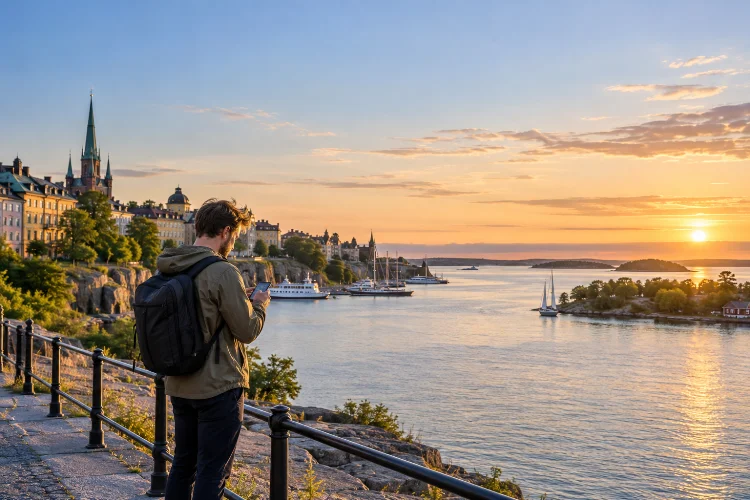
Summer in Northern Europe can completely change your sense of time. You finish dinner, look outside at 10:30 p.m., and the sky still feels bright enough to start another walk. Travel farther north, and the sun may not disappear below the horizon at all.
That extra daylight can make a Nordic summer trip feel incredibly generous. You can hike later, photograph cities when streets become quieter, take evening ferries, and explore landscapes without constantly racing against sunset.
But unlimited-looking daylight has a downside: it becomes surprisingly easy to overplan. Travelers may stay outside until midnight, sleep too little, and repeat the pattern until an exciting itinerary becomes exhausting.
Good Northern Europe travel strategies for long summer daylight are therefore about using the extra hours selectively.
Instead of treating every bright hour as sightseeing time, build your itinerary around energy, location, weather, and the special opportunities created by white nights and the Midnight Sun.
Understand How Far North Changes the Experience
Not every Northern European destination experiences summer light in the same way.
Stockholm already has remarkably long days. Visit Sweden notes that in July, daylight there stretches roughly from 3:40 a.m. until 10:00 p.m. Travel north into Arctic Sweden and the difference becomes much more dramatic: parts of the region can experience continuous daylight for weeks.
In Abisko, for example, Visit Sweden gives an approximate Midnight Sun period from May 25 to July 18, while Kiruna typically experiences it from around May 28 to July 14.
Northern Norway goes even further. Visit Norway lists Midnight Sun periods of roughly May 20 to July 22 in Tromsø and April 20 to August 22 in Svalbard.
So when planning, do not simply ask, “Am I visiting in summer?”
Ask how far north you are going and when.
Divide Your Day Into Activity Zones
Long daylight does not mean you need an 18-hour sightseeing schedule.
A better strategy is to divide the day into different activity zones.
Use the conventional daytime period for attractions with fixed opening hours: museums, guided tours, restaurants, markets, and indoor cultural sites. Save flexible outdoor experiences for later.
That might mean visiting a Stockholm museum in the afternoon and taking a waterfront walk at 9:30 p.m. In Finnish Lapland, you could rest after dinner and begin a short hike when the low evening sun gives the landscape a completely different atmosphere.
This works particularly well in areas with actual Midnight Sun.
Visit Finland notes that north of the Arctic Circle, summer can bring continuous sunlight for extended periods, while even Helsinki experiences exceptionally bright “white nights.”
Think of late evening as a bonus window rather than an extension of your normal sightseeing shift.
Use Late Light for Outdoor Experiences
The best use of Northern Europe’s summer daylight is usually outdoors.
Cities remain enjoyable late in the evening, but landscapes benefit even more. Hiking trails, lakes, fjords, archipelagos, and coastal roads become available during hours when travelers elsewhere would already be back at their hotels.
Northern Norway is a great example. The official tourism board highlights activities such as kayaking, hiking, cycling, fishing, and even swimming during the bright Arctic nights.
Swedish Lapland offers similar opportunities, with continuous daylight opening much wider windows for hiking and nature exploration
This can also improve photography. The sun stays low for longer periods, creating warmer and softer-looking light than harsh midday conditions.
Instead of rushing toward a famous viewpoint at noon, consider returning later when tour groups have thinned and the light is more atmospheric.
Protect Your Sleep From the Endless Light
One of the strangest things about a Nordic summer is realizing that your eyes no longer give you an obvious signal that the day is finished.
At 11:00 p.m., your hotel room may still look like late afternoon.
This is where simple planning becomes important. Choose accomodation with effective curtains when possible, especially in northern Scandinavia, Finland, or Iceland. Packing an eye mask is also one of the easiest ways to make summer travel more comfortable.
Keep a relatively consistent sleeping schedule even if the streets outside remain bright.
There is nothing wrong with enjoying one midnight hike or staying outdoors for a special sunset-that-never-quite-sets experience. The mistake is treating every night like that.
Remember that tomorrow also contains plenty of daylight.
You do not need to capture all of it tonight.
Move Transportation Into the Bright Evening Hours
Extended daylight can also improve itinerary logistics.
A late-afternoon train or evening ferry no longer automatically means arriving somewhere in darkness.
This can make certain transfer days feel less wasted. You might spend most of the day exploring Copenhagen, take an evening connection toward Sweden, and still arrive with enough natural light to orient yourself.
The same principle works for road trips.
Driving during daylight generally makes unfamiliar landscapes easier to appreciate, and Northern Europe’s exceptionally long summer evenings expand your useful driving window considerably.
But do not turn that flexibility into a reason for excessively long days.
A 9:00 p.m. arrival may be visually easy, but hotel reception hours, car-rental desks, restaurants, and public transport still follow actual clocks.
Daylight stays late. Businesses do not necessarily do the same.
Use the Midnight Sun Selectively
Seeing the Midnight Sun should feel special.
It loses some of that magic when your itinerary demands staying awake until midnight every evening for a week.
Choose one or two experiences where continuous daylight genuinely improves the activity.
In Lofoten, that could be a late coastal walk. Around Tromsø, perhaps a nighttime kayak trip. In Finnish Lapland, it might be hiking, swimming, or simply sitting beside a lake when the sun remains above the horizon.
Visit Finland describes summer north of the Arctic Circle as a period when the sun can remain visible around the clock, making activities possible at hours that would normally feel like nighttime.
Iceland offers another version of the experience. Its official tourism site describes June as a period of long days and Midnight Sun conditions that greatly extend opportunities for outdoor exploration.
Build the trip around a few memorable late nights rather than collecting them compulsively.
Schedule Recovery Mornings
Here is one of the most useful tricks: if you plan a late night, protect the following morning.
Do not schedule a 6:30 a.m. train after photographing the Midnight Sun until 1:00 a.m.
Instead, create a slower morning with a late breakfast, sauna, café visit, easy neighborhood walk, or flexible departure.
This gives the itinerary rhythm.
For example, you might spend one evening hiking near Tromsø until midnight, sleep later, then use the next afternoon for a museum or relaxed harbor exploration.
The same approach works in Iceland, Swedish Lapland, and northern Finland.
Travel fatigue usually comes from stacking demanding experiences without recovery – not from one adventurous night.
Planning rest deliberately means you can use unusual daylight conditions without feeling completely exhausted four days later.
Keep Weather More Important Than the Clock
Twenty-four-hour daylight does not guarantee twenty-four-hour perfect weather.
Northern Norway can produce dramatic changes even during summer. Visit Norway notes that temperatures and conditions in the north can vary considerably, with rain, wind, cold spells, and much warmer days all possible.
This actually creates another advantage of long daylight: flexibility.
Suppose rain covers the mountains all morning but clears at 7:00 p.m. In southern destinations, your hiking window might be gone. In Arctic summer, several usable hours can remain.
Keep outdoor plans somewhat flexible and move indoor activities into poor-weather periods.
Pack layers and waterproof clothing even when traveling in June or July.
The endlessly bright sky can make Northern Europe look permanently summery in photographs. The temperature may disagree.
Use White Nights Differently From True Midnight Sun
You do not need to cross the Arctic Circle to benefit from extraordinary summer light.
Stockholm, Helsinki, Copenhagen, and Reykjavík experience very long summer days even when the sun technically drops below the horizon. Stockholm, for example, remains light deep into the evening in midsummer.
In southern Finland, nights can remain remarkably bright. Visit Finland describes Helsinki’s summer as having “white nights,” when darkness barely takes hold before morning returns.
These cities are perfect for late urban exploration.
Visit major attractions earlier, take a break around dinner, then return outside for waterfronts, parks, architecture, viewpoints, or quiet neighbourhood walks.
This split-day approach is often far more confortable than sightseeing nonstop from breakfast until midnight.
Do Not Confuse Summer With Guaranteed Warmth
Long daylight and warm weather are two seperate things.
Northern Europe can be sunny and pleasantly mild, but conditions can change rapidly, particularly around coasts, mountains, and Arctic regions.
Visit Norway notes that summer temperatures in the country vary widely by region, with warm spells possible in southern areas while northern conditions can remain much cooler.
That means your packing strategy should still include light layers, a waterproof shell, and something warmer for late outdoor activities.
Midnight hiking in a T-shirt may look great on social media.
Wind beside an Arctic fjord at 12:30 a.m. may definately have different plans.
Plan for the conditions, not just the season written on the calendar.
Northern Europe’s long summer daylight gives travelers something genuinely unusual: more freedom over when a travel day begins and ends.
Instead of rushing through outdoor attractions before sunset, you can hike, walk, photograph, kayak, or explore cities deep into the evening.
The smartest strategy, however, is not staying awake for every available hour. Use conventional daytime for fixed attractions, reserve selected evenings for outdoor adventures, protect your sleep, and schedule easier mornings after late experiences.
Most importantly, let weather and energy guide the itinerary rather than daylight alone.
Before your trip, check the exact daylight conditions for every destination and date. Then choose a few evenings where the extended light truly adds something special. Northern summer feels much more magical when you enjoy it rather than trying to outrun it.
