
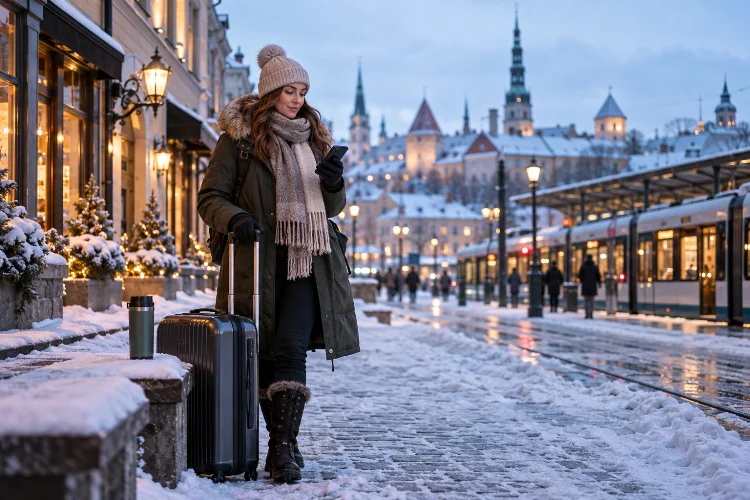
Winter can completely transform Northern Europe. Copenhagen becomes quieter and moodier, Tallinn’s medieval streets feel almost cinematic under snow, and northern Finland or Sweden can deliver landscapes that seem completely disconnected from everyday city life.
But a successful winter trip requires different planning from a summer itinerary. Short daylight hours affect sightseeing, snow and wind can disrupt transportation, and temperatures can change dramatically between coastal capitals and Arctic interiors.
That is why advanced winter planning for Nordic and Baltic destinations should begin with more than a weather forecast.
You need to consider daylight, transportation buffers, clothing, activity timing, and the possibility that nature simply refuses to follow your schedule.
The Nordic and Baltic regions also offer very different winter experiences. You might combine Stockholm and Helsinki with snowy Lapland, or move through Tallinn, Riga, and Vilnius for atmospheric city breaks.
The key is designing a trip that works with winter rather than constantly fighting against it.
Plan Around Daylight Before Attractions
In Northern Europe, daylight should be one of the first things you check when building a winter itinerary.
Stockholm, for example, has sunrise around 8:47 a.m. and sunset around 2:55 p.m. in January. Farther north in Sweden, winter can bring periods when the sun never rises above the horizon at all.
Northern Norway experiences an even more dramatic version. In much of the region, the sun may remain below the horizon or only briefly appear between mid-November and late January.
Southern Norway, by comparison, can still receive roughly six to eight hours of winter daylight.
Use those precious daylight hours for activities that depend on visibility: viewpoints, outdoor photography, countryside trips, hiking, or architecture.
Museums, restaurants, saunas, cafés, and shopping can wait until darkness.
This simple switch can dramatically improve how productive your winter days feel.
Understand That “Nordic Winter” Is Not One Climate
Do not pack for Oslo, Tromsø, Helsinki, and Rovaniemi as though they have identical weather.
Norway’s coastal areas can remain relatively mild because of maritime influences, while inland areas may become dramatically colder. Visit Norway notes that some inland locations can fall 10–20°C below zero, with exceptional conditions dropping much farther.
Finland shows a similar north-south difference. Visit Finland gives typical winter ranges around -10°C to -20°C for Rovaniemi and roughly -3°C to -8°C for Helsinki.
Meanwhile, Estonia’s winter season typically runs from late November into early March, with temperatures commonly around -1°C to -10°C.
Wind matters too.
A relatively modest temperature can feel much colder along exposed coastlines, ferry terminals, or Arctic plateaus.
Check forecasts by destination rather than using one general forecast for the whole trip.
Build More Buffer Into Winter Transportation
A summer itinerary might comfortably rely on several tightly connected trains, ferries, and flights.
Winter deserves more breathing room.
Snow, wind, storms, infrastructure problems, and temporary service changes can affect transportation. Visit Norway specifically warns that winter storms around places such as Lofoten can cause transport disruption and recommends allowing time for delays.
Rail travel is not immune either. Operators such as Finland’s VR publish real-time delay, cancellation, and replacement-bus information when services are disrupted.
Avoid scheduling an important long-haul flight immediately after a complicated Arctic connection.
If your international flight departs from Helsinki on Saturday morning, arriving from Lapland on Friday – or even Thursday during uncertain weather – can provide valuable protection.
The same principle applies to ferries between Nordic and Baltic cities.
Winter efficiency is not about creating the tightest possible schedule. It is about creating one that can survive a disruption.
Pack for Layers, Not One Giant Coat
One enormous winter jacket is not a complete cold-weather strategy.
Layering works better because your environment changes constantly. You may spend an hour outdoors at -15°C, then immediately enter a heated museum, train, restaurant, or hotel lobby.
Visit Finland recommends thermal base layers, wind-resistant outerwear, insulated winter boots, and wool for cold conditions.
A practical system starts with a moisture-managing base layer, followed by an insulating mid-layer and a windproof or waterproof outer shell.
Then pay attention to the smaller pieces.
Warm socks, gloves, a hat, neck protection, and insulated footwear can matter as much as your main jacket. Snow-covered sidewalks also make good traction useful.
Avoid packing cotton as your primary cold-weather layer for long outdoor activities because it performs poorly when wet.
And remember that Baltic city travel may require less extreme equipment than Arctic expeditions. Dressing for actual conditions will be far more confortable than hauling expedition-level clothing through every hotel.
Treat the Northern Lights as a Bonus, Not an Appointment
Aurora trips can become frustrating when travelers schedule one specific evening and assume the sky will cooperate.
The Northern Lights do not take reservations.
Visit Finland says the aurora season generally runs from late August into early April, with particularly strong activity around September-October and February-March. In northern Finland, auroras may be visible on roughly every second clear night during favorable periods.
The phrase clear night matters.
Cloud cover can completely block a strong aurora display. Solar activity alone is not enough.
If seeing the Northern Lights is a major goal, spend several nights in an aurora-friendly location rather than arriving for one evening and leaving the next morning.
Check two forecasts
Monitor both the normal weather forecast and a space-weather or aurora forecast.
Visit Finland specifically recommends checking cloud conditions alongside geomagnetic activity.
That approach gives you flexiblity to move outdoor activities around when the sky looks promising.
Separate Arctic Winter From Baltic City Winter
A winter trip to Riga is not the same type of vacation as a winter trip to Finnish Lapland.
Baltic capitals often work beautifully as atmospheric cultural breaks. Tallinn, Riga, and Vilnius combine historic centers, museums, cafés, restaurants, seasonal markets, and easy indoor alternatives when the weather becomes unpleasant.
Latvia’s official tourism organization points out that winter also brings fewer visitors and can mean lower demand for flights and accomodation than the main summer season.
Arctic destinations are more activity-driven.
Finnish Lapland, northern Sweden, and Northern Norway are popular for skiing, snowshoeing, husky experiences, reindeer activities, snowmobiling, and aurora viewing.
Finland’s winter activity season can stretch for months, with Lapland ski areas operating well beyond the period when southern Europe is thinking about spring.
A smart itinerary might therefore alternate them.
Spend several active days outdoors in Lapland, then move south to Helsinki or Tallinn for cafés, museums, sauna, and a slower pace.
That contrast can make a long winter journey much easier physically.
Design the Trip Around Energy, Not Maximum Sightseeing
Cold weather consumes energy in ways that are easy to underestimate.
Walking through snow takes more effort. Heavy clothing makes movement slower. Darkness can change your natural sense of time, and simply waiting outside for transportation becomes more demanding.
Do not plan winter days as aggressively as summer days.
Three major activities may be better than six minor ones.
Build warm-up stops into the itinerary. A café break after several hours outside is not wasted sightseeing time; it can be what allows you to enjoy another two hours later.
Also consider traveling in late winter.
Visit Finland notes that March and April bring considerably more daylight to Lapland while still offering strong winter conditions.
Swedish Arctic regions also become progressively brighter as winter moves toward spring, creating a different balance between snow activities and usable daylight.
December and January offer extreme darkness and a distinctive Arctic atmosphere, while February and March can be easier for travelers who want winter scenery without the shortest days.
There is no single “best” winter month.
Choose based on the experience you actually want.
Keep One Flexible Day in Longer Itineraries
If your trip lasts ten days or more, leaving one day mostly unstructured is surprisingly powerful.
Maybe weather cancels the excursion you wanted. Perhaps your train arrives six hours late. Or maybe the previous night’s aurora hunt kept you outside until 2:00 a.m.
A free day lets you recover without sacrificing the rest of the itinerary.
This becomes even more important when traveling through several countries.
For example:
Stockholm → Helsinki → Rovaniemi → Tallinn → Riga
looks relatively simple, but it involves rail, potentially overnight travel, ferry connections, major temperature changes, and several hotel moves.
Do not schedule every arrival immediately before a non-refundable activity.
Winter rewards travellers who can adapt.
Some of the best days may happen precisely because your original plan changed.
Advanced winter travel across the Nordic and Baltic regions is less about defeating cold weather and more about designing around it.
Short daylight, snow, wind, transportation disruption, and rapidly changing conditions should shape the itinerary from the beginning.
Use daylight for outdoor experiences, layer clothing properly, protect important connections with larger buffers, and give aurora destinations several nights rather than one desperate attempt.
Balance demanding Arctic activities with slower city stays in places such as Helsinki, Tallinn, Riga, or Stockholm. Most importantly, keep some space in the schedule.
Before booking your trip, check historical daylight, realistic temperatures, transportation options, and seasonal activities for every destination.
A winter itinerary with fewer rigid commitments will definately give you more freedom to enjoy whatever Northern Europe decides to deliver.
