
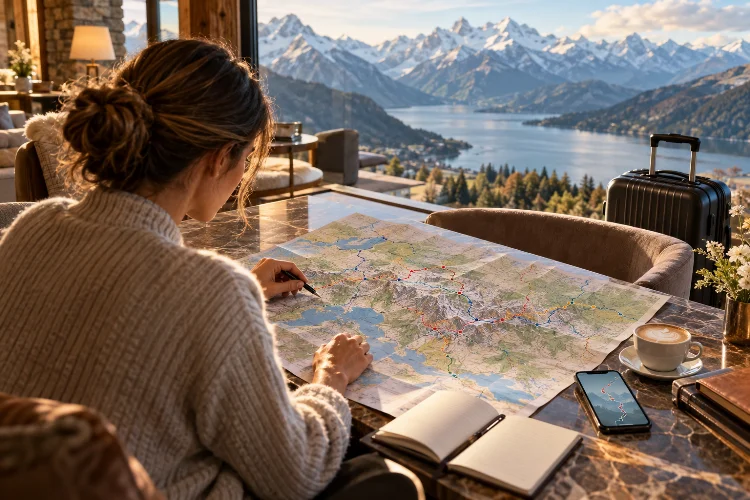
Planning a European mountain trip sounds simple until you realize how many different versions of the Alps exist.
Switzerland offers highly integrated mountain railways, Austria mixes historic cities with accessible valleys, northern Italy brings the dramatic Dolomites, and France combines high peaks with lakes, ski resorts, and major regional gateways.
The Alps themselves stretch across eight countries, including Austria, France, Germany, Italy, Liechtenstein, Monaco, Slovenia, and Switzerland.
That makes advanced Alpine travel planning across Europe’s mountain regions less about choosing one beautiful destination and more about connecting several landscapes efficiently
Mountain travel also works differently from normal European city-hopping. A short distance on a map can involve mountain passes, cable cars, seasonal roads, weather delays, or several changes between rail and local buses.
The best itineraries therefore balance spectacular scenery with realistic transportation, longer regional bases, and enough flexibility to change plans when the mountains decide otherwise.
Build Your Route Around Alpine Gateways
Start with gateway cities instead of individual peaks.
Places such as Geneva, Zurich, Innsbruck, Salzburg, Grenoble, Bolzano, and Milan provide access to surrounding mountain regions while remaining well connected to Europe’s larger rail network.
A route could move from Geneva → Swiss Alps → Innsbruck → Dolomites, for example, rather than jumping randomly between famous resorts in different corners of the mountain range.
Think in regional clusters. Switzerland can form one section, western Austria another, while Bolzano or Cortina can introduce the Italian Dolomites.
This approach reduces backtracking and gives each region enough time to feel different.
It also makes bad-weather days easier to handle. A larger gateway town usually offers museums, cafés, historical districts, thermal facilities, and other alternatives when high mountain conditions are poor.
Choose the Season Before Choosing the Activities
The Alps are not one destination operating the same way throughout the year.
Summer favors hiking, alpine lakes, cycling, scenic rail, and high-elevation walking.
France’s official tourism site highlights mountain hiking, alpine lakes, villages, and protected areas such as Vanoise and Écrins during the warmer season, while winter shifts the focus strongly toward snow sports
Winter brings skiing and snowy scenery, but some hiking routes and high mountain roads become inaccessible.
Then there are the shoulder seasons.
Late spring can look wonderfully green in the valleys while snow still affects higher trails. Autumn may offer quieter villages and beautiful landscapes, but some lifts, mountain huts, and seasonal attractions begin closing between summer and winter operations.
Before confirming accomodation, check whether the specific cable car, hiking route, mountain pass, or hut you want actually operates during your dates.
The calendar month alone does not tell the full story.
Let Rail Handle the Long-Distance Alpine Sections
You do not automatically need a rental car to explore the Alps.
Switzerland is particularly suited to rail-based travel. Its tourism authority highlights an extensive network of trains, buses, boats, mountain railways, funiculars, and cable cars, making it possible to connect major cities with high-altitude destinations without driving
Scenic rail can also become part of the trip.
The Bernina route crosses high Alpine scenery before descending toward a very different southern landscape, while Switzerland’s panoramic network includes routes such as the Glacier Express, GoldenPass, and Luzern–Interlaken Express.
Do not mistake scenic trains for ordinary transport you simply need to complete as quickly as possible.
Build time around them.
An eight-hour panoramic journey may look inefficient compared with a faster connection, but if the railway itself is one of the experiences you came to Europe for, those hours are sightseeing rather than lost time.
Understand the Alpine “Last Mile”
Long-distance transport is often the easy part.
The challenge begins when the main train leaves you in a valley and your hotel sits several hundred meters higher.
Mountain destinations frequently require a final bus, local railway, gondola, shuttle, taxi, or combination of them.
The Alpine Convention specifically identifies last-mile connections between valley stations and higher resorts as an important challenge for sustainable mountain mobility.
Always investigate this section before booking.
A hotel may look only 12 kilometers from a station on a map, yet reaching it without a car could require an infrequent bus. Another village farther away might have excellent integrated transportation.
Arrival time matters too.
A train reaching the valley at 9:30 p.m. is not useful if the final mountain bus finished operating at 8:00.
For complicated Alpine routes, the last 15 kilometers can require more planning than the previous 500.
Use Fewer Bases and Explore More Deeply
Constantly switching mountain hotels is exhausting.
Unlike city travel, moving through the Alps can involve steep streets, small stations, cable cars, and less frequent public transportation. Packing every morning quickly becomes annoying.
Choose strategic bases instead.
In Switzerland, a location such as Interlaken can support several excursions around the Bernese Oberland.
Innsbruck can combine urban culture with mountain access. Bolzano works as a gateway into South Tyrol, while Cortina provides access to spectacular sections of the Dolomites.
The Dolomites themselves are not one compact sightseeing attraction. UNESCO’s World Heritage property consists of nine component areas covering more than 141,000 hectares, with 18 peaks rising above 3,000 meters
Trying to “see the Dolomites” in one afternoon therefore makes little sense.
Stay several nights and choose a smaller area.
A three- or four-night base gives you more flexiblity to move hikes and cable-car excursions according to weather.
Build Weather Buffers Into Mountain Days
Mountains do not care about your reservation spreadsheet.
A clear morning can become cloudy by afternoon, high winds can close lifts, and rain can make an otherwise easy hiking plan much less enjoyable.
This is why one-night stays are risky when the scenery is the primary reason for visiting.
If you give yourself three days in a region, one rainy day does not ruin the entire experience.
Separate fixed and flexible activities as well. Train transfers and hotels may need advance booking, while a hike or viewpoint excursion can often be moved to whichever day has better conditions.
Check official local forecasts and lift status before heading upward.
Also remember that weather in the valley may be completely different from conditions at altitude.
Warm sunshine beside a lake does not guarantee equally mild conditions two vertical kilometers higher.
Keeping a lightweight waterproof layer and warmer clothing available is usually more useful than dressing only for the temperature outside your hotel.
Mix Famous Peaks With Quieter Landscapes
An advanced Alpine itinerary should not consist entirely of headline attractions.
Famous locations are famous for good reasons, but combining them with smaller valleys and villages produces a richer trip.
The French Alps, for example, extend beyond Mont Blanc and major ski resorts to include areas around Annecy, Vanoise, Chartreuse, Bauges, Vercors, and Écrins
The Dolomites also contain multiple distinct groups rather than one single viewpoint.
This matters for pacing.
Spend one day visiting a major mountain attraction, then follow it with an easier valley walk, lake excursion, village afternoon, or shorter local trail.
You will experience more variety and reduce the pressure to make every day an expedition.
It also helps distribute tourism more responsibly across Alpine communities.
Consider Trains Before Automatically Renting a Car
A rental car provides freedom in remote areas, but it also creates parking, traffic, road-condition, and mountain-driving concerns.
The Alpine Convention notes that the region is crossed by major international transport corridors and specifically promotes shifting more passenger movement toward rail because transport pressure has particularly strong environmental effects in mountain valleys.
A hybrid strategy often works best.
Use trains between countries and major Alpine regions, then rent a car only for a short area where public transport genuinely limits what you want to do.
This avoids driving hundreds of unnecessary kilometers.
It can also make the journey more enjoyable. Instead of concentrating on unfamiliar mountain roads, you can watch glaciers, valleys, villages, and rivers from a train window.
Keep the car for the places where it actually adds value rather than assuming you need one for the entire vacation.
Protect Space for Rest and Altitude Changes
Mountain itineraries can be physically demanding even when you are not doing technical hiking.
Walking uphill, carrying gear, taking early trains, and spending long periods outdoors can make consecutive activity days tiring.
Alternate demanding excursions with easier ones.
If one day involves a long hike, make the next a scenic railway, lake cruise, short village walk, or relaxed cable-car excursion.
Be especially conservative when moving quickly from low cities to much higher elevations.
Some Swiss mountain railways reach very high viewpoints; Switzerland Tourism, for example, lists Gornergrat at 3,089 meters.
You do not need to fill every available hour simply because the view is spectacular.
A slower itinerary often produces better mountain experiences than one involving a new summit every morning.
And if removing one destination gives you an extra weather day in the Alps, it is definately worth considering.
Advanced Alpine travel works best when the mountains shape the itinerary rather than being squeezed into a standard European city schedule.
Choose regional gateways, travel in one logical direction, check seasonal access, and calculate the last mile before reserving remote accommodation.
Rail is especially valuable for crossing major Alpine regions, while cars can be saved for places where they genuinely improve access. Longer stays also give you essential weather flexibility and reduce exhausting hotel changes.
Most importantly, avoid treating Switzerland, Austria, the French Alps, and the Dolomites as interchangeable mountain scenery. Each region has its own geography, transportation, culture, and rhythm.
Before booking, choose two or three Alpine bases and research what you can reach from each. A simpler mountain route usually delivers a much bigger adventure.
