
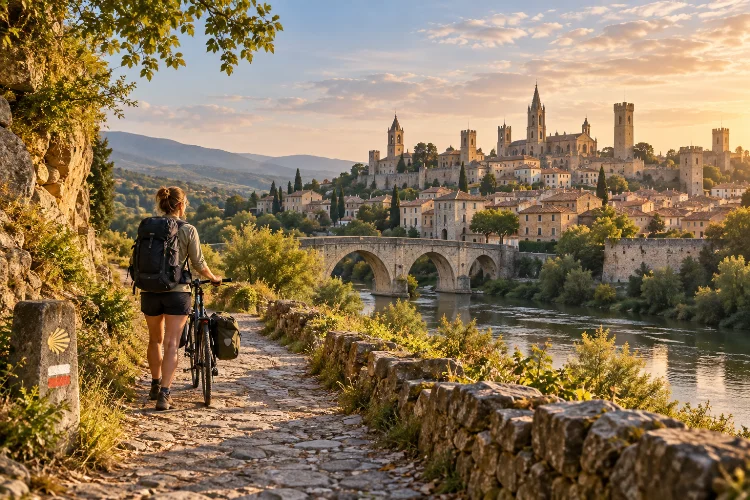
Europe makes much more sense when you stop viewing its historic cities as isolated dots on a map.
Medieval merchants, pilgrims, craftsmen, rulers, scholars, and religious communities moved constantly between towns, carrying goods, architectural ideas, languages, beliefs, and traditions with them.
Many of those connections survive today as heritage trails and cultural routes. Some follow physical roads that travelers can still walk, while others link cities through a shared historical theme rather than one continuous path.
Understanding how heritage trails connect Europe’s historic cities and towns can completely change the way you build an itinerary.
Instead of jumping randomly between famous old centers, you can follow the Hanseatic trading world around Northern Europe, travel sections of the Via Francigena toward Rome, or trace the east-west corridor of the VIA REGIA.
The Council of Europe’s Cultural Routes programme now includes more than 45 certified routes covering architecture, landscapes, religion, food, art, literature, and other shared heritage.
That creates a powerful framework for slower, more meaningful European travel.
Think of Heritage Trails as Historical Networks
A heritage trail does not always mean a painted line on the ground.
Some routes are traditional pilgrimage paths that can still be followed on foot. Others connect ports, market towns, monasteries, archaeological sites, castles, and cultural landscapes spread across several countries.
This distinction matters when planning a trip.
You might walk selected sections of a pilgrimage road, use trains between Hanseatic cities, and combine regional rail with cycling along an old commercial corridor.
The Council of Europe’s Cultural Routes programme was launched in 1987 to highlight exactly these kinds of shared connections. Its routes are designed around history that crosses modern national borders and links communities through common cultural themes.
For travelers, the advantage is simple: the route gives your journey a story.
Instead of asking what city comes next, you ask why these cities belong together.
Follow Medieval Trade Through the Hanseatic Cities
The Hansa is one of Europe’s best examples of a heritage network built around urban connections.
Beginning with associations of German seafaring merchants in the thirteenth century, the Hanseatic League eventually influenced trade, politics, and economic life across Northern Europe.
As many as 225 cities participated historically; today’s cultural network includes 190 cities across 16 countries.
That creates countless itinerary possibilities.
A route might start in Lübeck, continue toward Hamburg, move through Gdańsk, and eventually reach Baltic cities such as Riga and Tallinn.
Lübeck is particularly useful as an anchor. UNESCO describes it as one of the principal Hanseatic cities between 1230 and 1535, with its historic urban layout, merchant residences, churches, salt storehouses, and Holstentor still reflecting its commercial importance.
When exploring these places, look beyond major monuments. Waterfronts, warehouses, town halls, market squares, merchant houses, and old port districts often explain the city’s history better than another cathedral visit.
Cross Europe Along the VIA REGIA
The VIA REGIA shows how one route can connect completely different regions.
Known historically as the Royal Road, it developed into one of Europe’s most important east-west corridors. Its modern cultural route extends approximately 4,500 kilometers through ten European countries.
The road changed over time rather than following one perfectly fixed line.
That is actually useful for modern travelers because it means you do not need to reproduce an exact medieval itinerary.
You could connect historic cities such as Frankfurt, Erfurt, Leipzig, Görlitz, Wrocław, and Kraków, using modern rail between major stops and exploring older streets and regional heritage after arrival.
The route historically carried more than traders. Migrants, soldiers, rulers, pilgrims, and ideas moved along the same corridor.
That makes a VIA REGIA trip broader than architecture alone.
Each town becomes one chapter in a much longer European story.
Experience Pilgrimage History on the Via Francigena
Pilgrimage trails create a different relationship with historic towns because the spaces between destinations matter too.
The Via Francigena was reconstructed partly from the travel record of Archbishop Sigeric of Canterbury, who documented 79 stages on his return journey from Rome in 990.
The modern route now stretches roughly 3,200 kilometers from Canterbury through France and Switzerland to Italy and onward toward Santa Maria di Leuca.
You do not need several months to experience it.
A traveler might choose a shorter Tuscan section connecting places such as Lucca, San Gimignano, Siena, and smaller towns nearby.
Walk some sections, then use buses or trains where necessary.
This mix keeps the journey practical while preserving some of the slower rhythm that made pilgrimage routes historically important.
It also encourages travelers to notice rural churches, bridges, farmland, villages, and roadside heritage that would be invisible from a high-speed train.
See How Santiago Routes Created Connected Towns
The routes toward Santiago de Compostela demonstrate how pilgrimage could shape urban development across huge areas.
UNESCO’s Routes of Santiago de Compostela in France identify four symbolic approaches beginning from Paris, Vézelay, Le Puy, and Arles.
Along them, churches, sanctuaries, bridges, hospitals, and other structures reflect both the spiritual and practical needs of medieval travelers.
Across northern Spain, UNESCO’s related property covers a network of almost 1,500 kilometers, including coastal and inland pilgrimage corridors.
That means the famous destination is only one part of the experience.
Smaller towns developed infrastructure because people were constantly passing through them. Hostels, bridges, religious buildings, markets, and local services became part of the pilgrimage ecosystem.
Modern travelers can use the same logic.
Instead of rushing straight to Santiago, spend time in the smaller communities along the route. Their scale often makes the historical connection easier to understand.
Use Historic Cities as Bases for Smaller Towns
You do not need to change accomodation every night to follow a heritage trail.
A better strategy is to choose a few major bases and explore smaller historic towns around them.
For example, one Hanseatic city might serve as a three-night base while you make regional day trips. On a pilgrimage route, you might spend several nights in a larger town and walk nearby trail sections without carrying luggage every day.
This makes heritage travel much easier physically.
It also gives you time to experience historic centers early in the morning and after evening crowds disappear.
The same rule applies to train-based routes.
If two historic towns are only an hour apart by regional rail, staying in one place may be more efficient than creating another hotel transfer.
A map full of different hotel names can look impressive during planning, but constantly repacking can quickly become exhausting.
Compare Cities Instead of Collecting Them
Heritage trails become more interesting when you actively compare what you see.
A Hanseatic port city developed differently from a pilgrimage town. A royal trading center along the VIA REGIA may have a different street pattern from a town shaped around a monastery.
Ask simple questions.
Why is the market square located here? Why are warehouses beside this river? Why is the cathedral so large compared with the rest of the town? Why did travelers need a bridge or hospital at this particular location?
These questions turn attractive architecture into evidence.
They also help prevent what could be called “old-town fatigue.”
After several days of Gothic churches and cobbled streets, places can start blending together unless you understand what made each settlement different.
Spend time in local museums and less-famous neigbourhoods. Small historical collections often explain regional connections far better than crowded landmark interiors.
Match Modern Transport to the Historical Route
There is no need to recreate medieval travel conditions.
Use high-speed and regional trains to cover long distances, ferries around maritime networks, buses for smaller towns, and walking where slower movement adds something meaningful.
A Hanseatic itinerary naturally suits rail and ferry travel.
The VIA REGIA works well as a train-based multi-city journey with occasional walking sections. Routes such as the Via Francigena or Santiago trails invite much more travel on foot.
You can also mix modes within one trip.
Travel 200 kilometers by train, check into a hotel, and walk 15 kilometers of the historical trail the following morning.
This is often more satisfying than trying to complete huge distances purely for the achievement.
Modern transport gives you the freedom to choose where slowing down matters most.
Leave Space for the Places Between Famous Stops
The most memorable heritage destinations are not always the names you recognized before the trip.
A smaller town may retain its medieval street plan more clearly than a famous capital. An old bridge, monastery, defensive gate, or market hall may provide a stronger connection to the route’s history than a heavily visited headline attraction.
This is why heritage itineraries need spare time.
Avoid scheduling every hour.
Leave an afternoon for a local museum, a riverside walk, or a seperate village that someone recommends after you arrive.
Historic routes were never made only from major cities.
Their importance came from networks of large and small communities supporting travelers, trade, religion, and cultural exchange.
Modern tourism often focuses on the destinations at the ends of the lines.
Heritage travel becomes more rewarding when you pay attention to everything in between.
Travel Slowly Enough to Support Living Heritage
Europe’s historic towns are not open-air museums.
People still live, work, shop, and raise families in them. Heritage tourism works best when visitors recognize that reality.
Staying overnight can support local hotels and restaurants while also allowing you to experience the town outside peak day-trip hours.
Use local guides, visit regional museums, eat outside the most famous square, and consider traveling during shoulder season.
The Council of Europe describes cultural routes as resources for responsible tourism and sustainable development, not simply as collections of historic attractions.
That perspective matters.
A successful heritage journey should leave you with a better understanding of how communities are connected, not just a larger folder of photographs.
And when choosing between five rushed towns and three explored properly, the slower option will definately reveal more.
Heritage trails make Europe’s historic cities and towns easier to understand because they restore the connections that modern borders often hide.
Hanseatic merchants linked northern ports, the VIA REGIA moved people and goods between east and west, while pilgrimage networks such as the Via Francigena and Santiago routes connected communities across enormous distances.
The best way to explore them today is not to reproduce every kilometer. Choose one historical theme, identify several strong anchor cities, and mix trains, walking, ferries, or regional transport according to the route.
Most importantly, leave time for smaller towns and unexpected discoveries.
Before planning your next European trip, choose a heritage trail first and destinations second. You may find that the journey between famous places becomes just as interesting as the landmarks themselves.
