
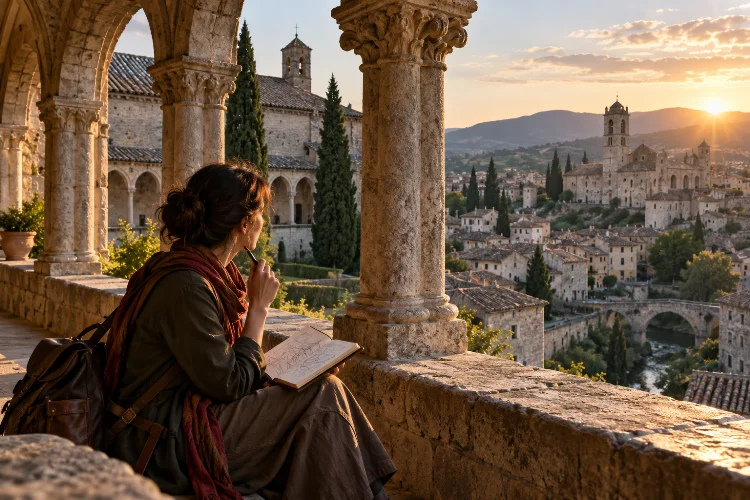
Europe’s medieval heritage is much bigger than a collection of castles, cathedrals, and cobbled streets.
Between roughly the fifth and fifteenth centuries, monasteries became intellectual centers, merchant networks connected distant ports, pilgrims crossed entire kingdoms, and expanding cities developed political and cultural identities that can still be seen today.
That makes medieval Europe especially rewarding for travelers who want more than a standard sightseeing checklist. Advanced cultural journeys across medieval European regions connect places through shared history rather than modern borders.
A trip might follow Hanseatic merchants around the Baltic, trace pilgrimage roads through France and Italy, or explore how monasteries influenced landscapes across Western Europe.
The smartest approach is to choose a historical theme, create regional clusters, and spend enough time in each area to understand what you are seeing.
Instead of collecting old buildings, you begin recognizing how religion, commerce, warfare, art, and urban planning shaped entire regions – and how those connections remain visible in modern Europe.
Start With a Medieval Story, Not a Country Checklist
Planning medieval travel around modern national borders can hide the very connections that make the period interesting.
A better strategy is to choose a theme first. Pilgrimage, monasticism, medieval trade, Gothic architecture, fortified cities, royal power, and religious orders can each become the backbone of an itinerary.
For example, the Cluniac monastic network began with the foundation of Cluny Abbey in Burgundy in the early tenth century.
The movement eventually influenced more than 1,800 sites across Western Europe, leaving monasteries, villages, castles, vineyards, mills, manuscripts, and cultural traditions behind.
That means a medieval journey does not have to concentrate on one famous abbey.
You could explore Burgundy, continue into Switzerland or northern Italy, and use surviving Cluniac sites to understand how religious institutions once connected distant European regions.
Use Medieval Cities as Regional Anchors
Some historic cities deserve several nights because their medieval identity extends far beyond a single monument.
Prague is a strong Central European example. UNESCO describes its historic center as an important expression of medieval urban development, particularly during the fourteenth century under Charles IV.
Prague Castle, St. Vitus Cathedral, Charles Bridge, churches, palaces, and its medieval street structure collectively reveal the city’s importance as a political and cultural center.
Instead of treating Prague as a two-hour Old Town photo stop, make it an anchor.
Spend time in different quarters, visit religious buildings, follow the Vltava, and examine how medieval streets connect spaces of royal, commercial, and religious power.
Then use regional rail to add smaller towns or castles nearby.
The same principle works with cities such as Kraków, York, Bruges, Ghent, Tallinn, and Regensburg. A strong base reduces accomodation changes while making the wider historical landscape easier to understand.
Follow Medieval Pilgrimage Routes Slowly
Pilgrimage roads are among the best ways to experience medieval geography.
The Via Francigena is particularly important. Its reconstructed route draws partly on the recorded 990 journey of Archbishop Sigeric from Canterbury to Rome.
Today, travelers can follow the historic corridor through several countries, experiencing architecture ranging from Romanesque and Gothic to later styles along the way
You do not need to walk thousands of kilometers.
Choose a manageable region.
In Tuscany, for example, sections around Lucca, San Gimignano, Siena, and the surrounding countryside can combine walking with buses and regional trains.
Walking even part of a medieval route changes your perception of distance. A church that looks insignificant on a Google Maps screen feels very different after you have approached it on foot through the landscape.
This is one situation where slower transportation actually improves the historical experience.
Explore the Merchant Cities of Hanseatic Europe
Medieval Europe was connected by commerce as much as religion.
The Hanseatic League grew from associations of seafaring merchants during the thirteenth century and eventually involved as many as 225 cities around northern Europe. Its modern cultural network includes 190 cities across 16 countries.
That gives travelers an enormous choice of routes.
One possible journey could follow Lübeck → Hamburg → Gdańsk → Riga → Tallinn, combining trains, ferries, and regional transport.
Look beyond major churches.
Merchant houses, warehouses, harbors, town halls, market squares, defensive walls, and trading districts tell the economic story more clearly.
Historic waterfront neigbourhoods can be especially revealing because they show how wealth entered cities before funding cathedrals, guild halls, and civic architecture.
A Hanseatic journey is therefore not simply about medieval buildings. It is about understanding why those buildings appeared where they did.
Compare Different Models of Medieval Urban Life
Not every medieval city developed in the same way.
Siena offers a fascinating contrast to Central and Northern European trading cities. UNESCO describes its historic center as an exceptional medieval urban environment whose Gothic appearance developed mainly between the twelfth and fifteenth centuries.
The city’s streets converge around Piazza del Campo, while walls, tower houses, palaces, churches, and fountains preserve much of its historic character
Pairing Siena with Prague, for example, reveals two very different expressions of medieval urbanism.
Prague developed as a major Central European political and religious center. Siena grew through the civic identity and artistic ambitions of an Italian city-state.
Travel becomes more interesting when you compare these differences instead of simply describing both places as “beautiful medieval towns.”
Ask what created each city: royal authority, merchant wealth, religious institutions, military strategy, or civic competition?
That question turns architecture into history.
Include Castles, Monasteries, and Rural Landscapes
City centers tell only part of the medieval story.
Castles controlled roads and territory. Monasteries managed land, education, agriculture, and religious life. Villages and agricultural landscapes supported everything happening behind urban walls.
Malbork Castle in Poland, for example, developed as a fortified monastery of the Teutonic Order and became the Grand Master’s seat after 1309. UNESCO regards it as an outstanding example of medieval brick castle architecture.
Sites like Malbork work particularly well when paired with nearby cities rather than treated as isolated attractions.
The same applies to abbeys.
The Cluniac network extended far beyond churches into vineyards, mills, settlements, manuscripts, and artistic traditions.
Mixing cities with rural heritage prevents medieval travel from becoming visually repetitive.
A fortified town feels different after a day in monastic countryside, and both become easier to understand in context.
Build Contrast Into the Itinerary
Seven medieval towns in seven days sounds impressive until every stone wall begins looking the same.
Contrast is essential.
Combine a large political center such as Prague with a small walled settlement. Follow a merchant city with a monastery. Alternate museums with walking routes, castles, markets, and landscapes.
Siena can provide dense Gothic urbanism, while Tuscany outside the walls offers a completely different relationship between settlement and countryside.
Northern Europe provides similar opportunities: combine Hanseatic ports with Teutonic castles or coastal landscapes.
Also leave some time without scheduled heritage attractions.
Sit in a market square, explore an ordinary residential street, or eat somewhere outside the main tourist zone.
Medieval cities are still living places. Understanding the modern community often makes the historical layers easier to appreciate.
Travel Slower Than Your Transport Allows
Modern trains make medieval Europe deceptively easy to rush.
You can travel hundreds of kilometers in a few hours, but cultural understanding does not move at high-speed rail velocity.
Try staying at least two or three nights in important historical bases. Longer stays allow you to experience early mornings and evenings after day visitors leave.
This also creates room for smaller museums and unexpected discoveries.
A regional archaeological collection might explain a town better than its famous cathedral. A local walking route could reveal medieval walls hidden behind later architecture.
Avoid filling every empty hour simply because transportation makes another destination possible.
Travelling slowly does not mean seeing less. It often means noticing more.
And when a historical region deserves four nights rather than two, staying put is definately more useful than adding another checkbox.
Treat Medieval Heritage as a Living Network
The most advanced way to experience medieval Europe is to stop thinking of historical sites as frozen relics.
The Hansa connected merchants across borders. Cluniac institutions created a religious network across Western Europe. Pilgrimage corridors such as the Via Francigena moved people, beliefs, information, and money between distant regions.
Those connections explain why architectural ideas and cultural traditions travelled so widely.
Modern cultural routes attempt to make those relationships visible again.
When designing your trip, identify one or two networks and follow them through several destinations. Use trains for major cities, buses for smaller towns, and walking routes where travelling slowly adds meaning.
Keep seperate sections of the journey focused enough that the historical story remains clear.
That creates something much richer than a collection of picturesque medieval photographs.
Advanced cultural travel through medieval Europe works best when destinations are connected by a historical idea.
Pilgrimage roads, merchant networks, monasteries, castles, Gothic cities, and rural landscapes reveal how Europe functioned long before today’s borders took their current form.
Choose a theme, establish two or three strong regional bases, and combine famous heritage sites with smaller towns and landscapes nearby. Allow enough time to compare how religion, commerce, political power, and geography shaped each place.
Most importantly, resist turning the journey into a race through old towns.
Before booking your next European adventure, choose one medieval story that genuinely interests you and trace where it leads. The resulting itinerary will usually feel more coherent, more memorable, and far more meaningful than another checklist of famous landmarks.
