
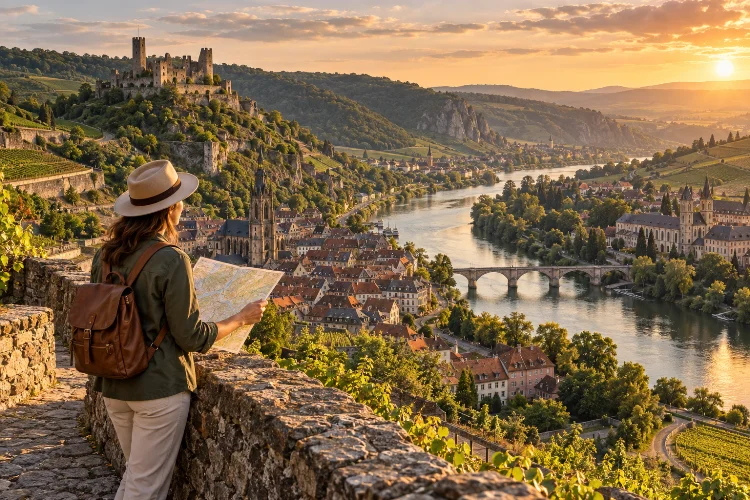
Europe becomes much more interesting when you stop treating historic places as isolated attractions.
A medieval cathedral in France, a fortified town in Germany, a Roman ruin beside the Danube, and an old trading port on the Baltic may belong to stories that stretch across modern national borders.
That is what makes advanced heritage routes through Europe’s historic regions so rewarding. Instead of jumping between famous landmarks, you follow a historical theme through landscapes, cities, villages, religious sites, trade routes, and archaeological remains.
Europe is particularly suited to this approach. The Council of Europe’s Cultural Routes programme now includes more than 45 certified routes covering themes ranging from architecture and pilgrimage to gastronomy, literature, art, and industrial history.
The result is a slower and more meaningful style of travel. Rather than asking, “What should I see next?”, you begin asking, “How does this place connect with what I saw yesterday?”
Build the Journey Around a Historical Theme
Start with a story rather than a list of countries.
A heritage itinerary could focus on Roman frontiers, medieval pilgrimage, Hanseatic trade, industrialization, monasteries, castles, Renaissance centers, or historic wine regions.
This immediately gives the journey structure.
The Council of Europe defines cultural routes broadly. They do not need to be one continuous physical road; they can also be networks of sites and regions connected by a shared historical concept.
That flexibility is useful.
A traveler interested in medieval commerce, for example, could follow the legacy of the Hanseatic League through cities around northern Europe and the Baltic instead of simply visiting random old towns.
Someone interested in Roman history might build a Danube-focused trip through archaeological sites, frontier landscapes, historic cities, and wine regions.
Once the theme is clear, destinations begin choosing themselves.
Use UNESCO Sites as Anchors, Not the Entire Itinerary
UNESCO World Heritage sites are excellent starting points because they identify places with exceptional cultural or natural significance.
But a sophisticated heritage trip should not become a race to collect UNESCO listings.
Use major sites as anchors, then explore the surrounding historical landscape.
UNESCO’s World Heritage Journeys initiative demonstrated this approach by connecting 34 European World Heritage sites into thematic journeys including Ancient Europe, Royal Europe, Romantic Europe, and Underground Europe.
The idea was to combine famous sites with surrounding communities and lesser-known heritage.
Consider Austria’s Wachau Valley. The UNESCO-listed cultural landscape extends roughly 36 kilometres along the Danube and combines vineyards, historic towns, monasteries, castles, and ruins.
Instead of visiting Melk Abbey and immediately returning to Vienna, you could spend several days moving through Melk, Dürnstein, Weißenkirchen, and Krems.
The heritage then becomes a landscape rather than a checklist.
Follow Europe’s Medieval Pilgrimage Networks
Pilgrimage routes offer some of Europe’s clearest examples of history becoming an itinerary. The Via Francigena is particularly ambitious.
Reconstructed partly from the journey recorded by Archbishop Sigeric in 990, the modern route stretches around 3,200 kilometres from Canterbury through France and Switzerland to Italy, eventually continuing beyond Rome toward Santa Maria di Leuca.
You obviously do not need to walk the whole thing.
Choose a historic section and travel slowly.
A week in Tuscany could combine portions of the route with towns such as Lucca, San Gimignano, Siena, and smaller settlements that feel very different from a conventional Florence–Rome itinerary.
The Santiago de Compostela network offers another model. UNESCO notes that medieval pilgrims passed through France using several important routes marked by churches, bridges, sanctuaries, hospitals, and other structures connected with pilgrimage life.
These routes work because the spaces between major monuments matter just as much as the monuments themselves.
Explore Trade History Through Hanseatic Europe
If cathedrals and pilgrimage roads are not your thing, build an itinerary around merchants.
The Hanseatic League shaped commerce and urban development across northern Europe from the Middle Ages into the early modern period. The Council of Europe’s modern Hansa cultural network includes 190 cities across 16 countries.
That opens countless route possibilities.
You might connect Lübeck with Hamburg before continuing toward Baltic cities such as Gdańsk, Riga, or Tallinn.
Instead of seeing their historic centers as unrelated collections of pretty buildings, you begin noticing warehouses, merchant houses, ports, churches, and market squares through the lens of regional trade.
This is where thematic travel becomes powerful.
Architecture that might otherwise look simply “old” gains context.
Spend time in local maritime museums and historical neigbourhoods, not only the central square. Markets, waterfronts, and former trading districts often explain a city’s history more clearly than its most photographed monument.
Follow Rome Beyond Rome
Roman heritage becomes much more interesting when you move beyond Rome itself.
The Roman Emperors and Danube Wine Route connects archaeological and cultural landscapes across ten European countries, including Hungary, Croatia, Serbia, Bulgaria, Romania, Slovenia, Bosnia and Herzegovina, Montenegro, Albania, and North Macedonia.
Its sites combine Roman history with the Danube frontier and long-established wine regions.
That means a trip can mix archaeological sites with contemporary landscapes rather than spending every day inside museums.
One route might begin around Budapest before following the Danube southeast through sections of Croatia, Serbia, and Romania. Another could focus on only one or two countries.
Do not try to cover the full route unless you have considerable time.
Historic regions reward depth. Three carefully chosen archaeological areas will usually teach you more than twelve sites visited at highway speed.
Include Industrial Heritage, Not Only Medieval Europe
European history did not stop when castles stopped being built.
Industrialization transformed cities, migration, transport, architecture, labor, and entire landscapes. Old mines, factories, shipyards, railway facilities, and steelworks can therefore be just as historically meaningful as palaces.
The European Route of Industrial Heritage, or ERIH, currently brings together around 350 members in 27 countries. Its database presents more than 2,400 sites, including over 100 major “Anchor Points” of industrial heritage.
This opens very different travel possibilities.
You could explore industrial Britain, Germany’s Ruhr region, mining areas in Central Europe, or textile and manufacturing heritage across several countries.
These places also tend to be less crowded than Europe’s headline medieval centers.
Pairing them with older heritage creates contrast. A trip might move from Gothic churches and aristocratic palaces into nineteenth-century factories and twentieth-century urban transformation.
Suddenly, European history feels continuous rather than divided into museum categories.
Slow Down in Historic Landscapes
The biggest mistake with heritage travel is moving too quickly.
Historic cities often reward walking, but entire cultural landscapes may require cycling, regional trains, boats, or driving.
The Wachau, for example, sits around an hour from Vienna by train, but rushing there and back in one afternoon misses much of what makes the region significant: villages, terraced vineyards, abbeys, ruins, and the Danube itself.
Use two- or three-night bases where possible.
Instead of changing accomodation every evening, stay in one historic center and explore nearby towns as day trips.
Also leave unscheduled hours.
Historic districts are especially enjoyable early in the morning and later in the evening, after tour groups disappear. You may discover that wandering without a route produces a stronger sense of place than another ticketed monument.
Slow travel is not inefficient here.
It is part of the method.
Connect Regions With Transport That Fits the History
Do not force every heritage itinerary into a rental car.
Rail works beautifully for routes connecting established cities, particularly across Germany, Austria, Czechia, northern Italy, Belgium, and parts of France. Regional trains can also reach many smaller historic towns.
Cars become more useful when castles, archaeological sites, monasteries, or rural landscapes are scattered away from major rail corridors.
Walking and cycling deserve serious consideration too.
Routes such as the Via Francigena were historically experienced at human speed. Covering selected sections on foot creates a completely different relationship with distance, geography, and settlement patterns.
You do not have to recreate medieval hardship.
Even walking 15 kilometres of a historical corridor before taking a train onward can change how you understand it.
Use different transportation styles for seperate parts of the trip rather than expecting one mode to handle everything.
Travel Responsibly Through Fragile Historic Places
Heritage tourism creates an obvious contradiction: visiting historic places helps support them, but excessive visitor pressure can also damage them.
UNESCO’s sustainable tourism work emphasizes heritage-based tourism that supports communities while protecting cultural values and creating high-quality local experiences.
Travelers can contribute in simple ways.
Stay overnight instead of arriving only for two crowded hours. Eat in locally operated restaurants, visit smaller museums, use local guides, and explore towns beyond their single famous square.
Consider shoulder season as well.
A medieval destination in May or October can feel far more atmospheric than during the busiest weeks of summer.
Most importantly, remember that historic towns are not movie sets. People live, work, worship, and raise families inside these heritage environments.
Treating them as living communities makes travel both more respectful and more interesting.
The best European heritage journeys connect places through a story. Roman frontiers, medieval pilgrimage roads, Hanseatic trade cities, Danube landscapes, and industrial regions all reveal histories that modern national borders can easily hide.
Start with one theme, choose a handful of anchor destinations, and leave enough time to explore the landscapes and smaller communities between them.
Use UNESCO sites as gateways rather than trophies, and combine trains, walking, cycling, boats, or driving according to the region.
Most importantly, resist trying to see everything.
Before your next European trip, choose one historical question you genuinely want to understand and build your itinerary around it. You will definately return home with more than photographs—you will come back understanding why those places belong together.
