
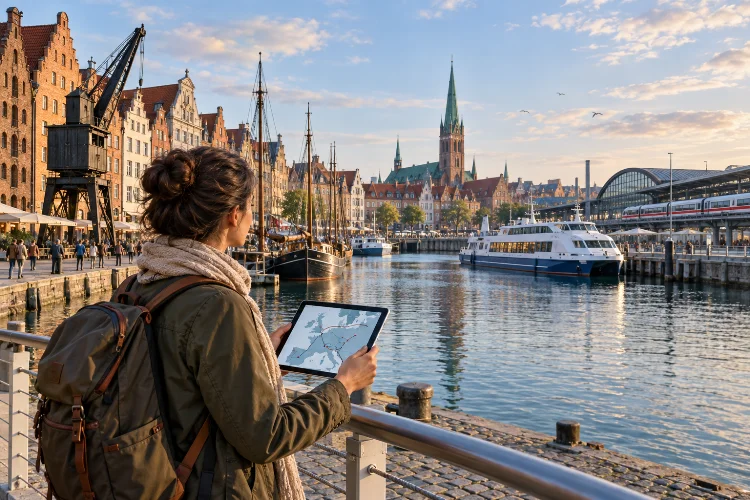
Europe’s modern railways, highways, ports, and city centers often follow patterns that started centuries – or even millennia – ago.
Long before tourists moved between Copenhagen, Lübeck, Kraków, Venice, or Barcelona, merchants were already carrying salt, timber, wine, textiles, metals, spices, ceramics, and countless other goods across the continent.
That history creates a fascinating way to plan a modern European journey. Instead of building an itinerary around famous capitals alone, you can follow the commercial networks that connected ports, rivers, market towns, royal roads, and trading settlements.
Exploring Europe’s historical trade routes through modern travel does not mean recreating an ancient merchant’s journey kilometer by kilometer. Many historical routes changed constantly, while others functioned as broad networks rather than single roads.
The smarter approach is to identify important trading regions and connect surviving markets, warehouses, harbors, medieval streets, castles, archaeological sites, and museums using today’s trains, ferries, cycling routes, and regional transport.
Suddenly, getting from one destination to another becomes part of the history.
Start With a Trade Story Instead of a Country List
A normal European itinerary might start with countries: Germany, Poland, Sweden, Italy, and Spain.
A trade-route journey begins differently.
Choose a story first. You could investigate medieval Baltic commerce, ancient Mediterranean seafaring, east-west overland trade, Viking trading settlements, or river commerce along the Rhine.
This approach mirrors the Council of Europe’s Cultural Routes programme, which connects heritage across present-day borders through shared historical themes. Its routes include the Hansa, Viking Route, VIA REGIA, and Phoenicians’ Route.
Once you have a theme, you do not need to visit every related destination.
Choose perhaps four to six important places and give each enough time. A focused Lübeck-Gdańsk-Riga-Tallinn journey can reveal far more about Baltic commerce than racing through ten former trading cities in twelve days.
Historical travel works best when the connections remain visible.
Follow the Hanseatic World Around Northern Europe
The Hanseatic League provides one of Europe’s easiest historical trade networks to explore today.
Beginning as associations of German merchants, the Hansa developed into a powerful commercial network around Northern Europe and particularly the Baltic.
At its historic height, as many as 225 cities participated, while the modern cultural network connects cities across numerous European countries.
A practical modern route might start in Lübeck, continue toward Hamburg, cross into Poland for Gdańsk, and then move through the Baltic capitals toward Riga and Tallinn.
Do not concentrate only on churches and town halls.
Look for waterfronts, former warehouses, merchant houses, market squares, city gates, and maritime museums. These spaces explain why certain towns became wealthy in the first place.
Read the architecture like economic history
Tall brick façades and enormous churches were not simply decorative achievements. They also reflected merchant wealth, civic competition, and the importance of urban trading communities.
Exploring a historic neigbourhood becomes more interesting when you understand what paid for it.
Cross Europe With the VIA REGIA
Not all trade networks depended on ships.
VIA REGIA, often translated as the “Royal Road,” represents one of Europe’s oldest major east-west corridors.
The modern cultural route stretches about 4,500 kilometers across ten European countries, while its history reaches back through medieval trade and much earlier movement across the continent.
Merchants shared the road with pilgrims, soldiers, rulers, migrants, and other travelers.
Today, parts of the historical corridor can be explored through cities such as Frankfurt, Erfurt, Leipzig, Görlitz, Wrocław, and Kraków, although the wider route extends much farther.
Modern rail makes this particularly interesting.
Instead of spending weeks moving at medieval speed, you can use trains between major centers and then slow down once you arrive. Walk historic streets, visit old marketplaces, and explore regional museums that explain how commerce shaped local development.
The Council of Europe even presents slower travel as part of the modern VIA REGIA experience, including possibilities ranging from walking to train journeys.
You get historical depth without needing a horse and cart.
Experience the Rhine as Europe’s River Highway
Rivers were Europe’s original high-capacity transportation infrastructure.
The Rhine is one of the best places to see how geography created commerce.
UNESCO describes the Upper Middle Rhine Valley between Bingen, Rüdesheim, and Koblenz as a strategic transport artery that generated prosperity over centuries.
Its approximately 65-kilometer World Heritage section contains historic settlements, vineyard terraces, and numerous castles that once watched over river traffic and trade.
That makes it ideal for modern slow travel.
Base yourself in one or two Rhine towns, combine regional trains with river boats, and stop in places such as Bacharach, Oberwesel, or Koblenz.
Many hilltop castles suddenly make more sense when viewed from the river below.
They were not placed there purely to create beautiful photographs centuries later. Control of movement, customs, territory, and commercial traffic helped shape the landscape.
This route is a perfect example of transportation becoming heritage.
Trace Viking Commerce Beyond the Famous Raids
Popular culture loves Viking warriors, but Viking history also involved extensive trade.
Their shipbuilding and navigation skills allowed travel throughout Northern and Western Europe, the North Atlantic, the Mediterranean, and deep into eastern European river systems. Important trading centers included Hedeby, Birka, York, Dublin, and Kyiv.
The modern Viking Cultural Route includes more than 60 locations featuring forts, farms, archaeological remains, museums, reconstructed buildings, ships, and former settlements.
For modern travelers, Scandinavia provides an obvious starting point.
Stockholm can be paired with Birka, while Denmark and northern Germany open access to additional Viking-era sites. Longer itineraries might continue toward Britain or Ireland.
Do not try to turn this into one continuous physical route. Viking trade was a network of maritime and river connections.
Think of your trip in the same way: several important nodes connected by modern ferries, railways, or flights.
Explore Ancient Mediterranean Commerce Through Phoenician Routes
Europe’s historical trading story extends much further back than the Middle Ages.
The Phoenicians developed maritime networks across the Mediterranean from at least the 12th century BC. The Council of Europe’s Phoenicians’ Route connects the major nautical corridors associated with trade and cultural communication between ancient Mediterranean civilizations.
For a modern European itinerary, this opens fascinating possibilities across Spain, France, Italy, Malta, Greece, Cyprus, Croatia, and other Mediterranean regions.
You could focus entirely on Sicily and surrounding areas, combine Mediterranean archaeological cities, or build an island-oriented journey using ferries and short flights.
The key concept is exchange.
Ancient merchants did not carry only objects. Maritime trade moved technologies, artistic influences, beliefs, languages, food traditions, and ideas between communities.
Visiting an archaeological port therefore tells a larger story than simply looking at ruins.
Pair historical sites with modern harbors and markets. The contrast between ancient and contemporary Mediterranean commerce makes these destinations feel much more alive.
Mix Trains, Ferries, Boats, and Walking
Historical trade routes were multimodal long before anyone invented that word.
Merchants switched between roads, rivers, coastal ships, sea routes, and local tracks depending on geography. Modern travelers should use the same logic.
Rail is excellent for connecting Hanseatic cities or stops along Central European corridors. Ferries make sense around Scandinavia and the Baltic.
River boats are perfect for portions of the Rhine, while walking or cycling lets you experience shorter historic sections at human speed.
Avoid forcing an entire itinerary into one transportation method.
Also calculate hotel-to-hotel time rather than only scheduled travel duration.
A ferry that takes four hours may require another hour to reach the terminal. A small historic town might lie only 50 kilometers away but require several regional connections.
Choose accomodation in transport hubs when exploring several nearby heritage sites. This reduces packing and lets you travel lighter during day trips.
Good logistics leave more attention for history.
Slow Down Enough to Notice What Trade Left Behind
Trade-route travel becomes meaningless if every stop lasts two hours.
Stay long enough to notice patterns.
Visit markets and maritime museums. Walk former harbor districts. Look at street names, warehouses, bridges, town gates, customs buildings, fortified riverbanks, and merchants’ residences.
Food also matters.
Commercial exchange influenced regional diets, spices, drinks, agricultural production, and cooking traditions. A local beer, wine, fish dish, or market product may have a surprisingly long connection with historical commerce.
Leave some time completely unscheduled.
The best discovery might be a small museum, restored warehouse, or seperate waterfront district that was never part of your original plan.
Trade shaped entire cities rather than isolated monuments. Your itinerary should give you time to experience them that way.
Europe’s historical trade routes offer a different way to understand the continent.
Instead of seeing each city as an independent destination, you begin noticing the commercial networks that linked ports, rivers, marketplaces, roads, and communities over thousands of years.
Follow Hanseatic merchants around the Baltic, travel sections of the VIA REGIA, cruise the Rhine, explore Viking trading settlements, or trace ancient Mediterranean exchange through Phoenician heritage.
You do not need to recreate an entire historic network. Choose one theme, identify a few strong destinations, and connect them using transportation that fits the geography.
Before planning your next European trip, ask what once moved between the places on your map. That simple question can definately turn an ordinary itinerary into a journey through Europe’s economic and cultural history.
