
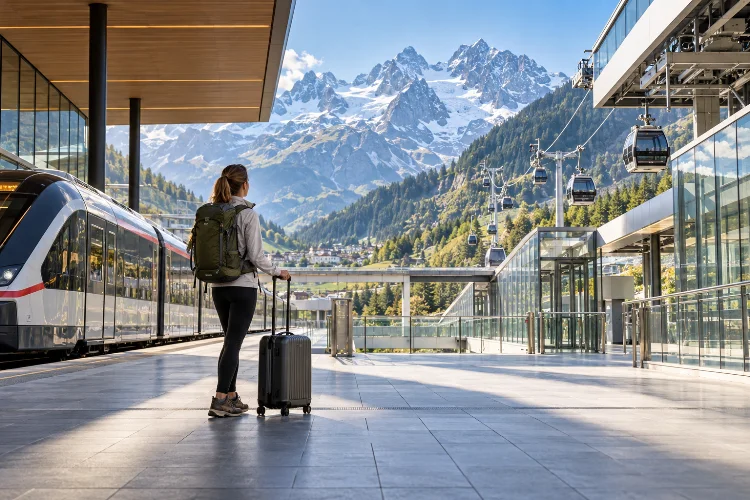
Travel across the European Alps looks very different once you stop thinking in terms of roads.
Trains disappear into mountain tunnels, cog railways climb slopes that ordinary railways could never handle, and cable cars turn a steep two-hour ascent into a journey of only a few minutes.
Together, these systems have changed what an Alpine itinerary can look like. Travelers can sleep in a valley town, ride into high mountain terrain after breakfast, complete a panoramic hike, and return to the same accommodation without renting a car or changing hotels.
Understanding how rail and cable cars shape travel across the European Alps is therefore useful for more than transportation planning.
These networks influence where you stay, which hikes are realistic, how many regions you can combine, and whether high-altitude landscapes are accessible to people who do not want – or are unable – to make long climbs.
From Switzerland’s mountain railways to Austria’s gondolas and the summer lift networks of the Dolomites, transportation is often part of the Alpine experience itself.
Think of Alpine Transport in Two Dimensions
Normal city transportation mostly moves horizontally. Mountain transportation has to solve a second problem: elevation.
A long-distance train may bring you from Zurich to a valley region, but reaching a mountain village or viewpoint can involve another local railway, funicular, gondola, or aerial cableway.
Switzerland demonstrates this layered system particularly well. Switzerland Tourism highlights an integrated travel network combining conventional trains, panoramic railways, boats, cog railways, funiculars, and cable cars.
That changes how you should read an Alpine map.
Two villages that appear close geographically may sit at dramatically different elevations. Meanwhile, a destination that looks isolated may actually be easy to reach because a train connects directly with a mountain lift.
When planning, check both horizontal distance and vertical access.
Railways Turn Mountain Transfers Into Sightseeing
Some Alpine rail journeys are valuable not simply because they get you somewhere, but because the route itself is part of the attraction.
Switzerland’s Matterhorn Gotthard Bahn, for example, runs across 144 kilometers of Alpine terrain between areas including Zermatt, Disentis, Andermatt, and Göschenen.
Switzerland Tourism notes that the railway crosses 126 bridges and viaducts and passes through 33 tunnels and galleries.
This creates a different planning mindset.
A conventional traveler might view four hours on a train as lost sightseeing time. In the Alps, those four hours might include mountain passes, glaciers, forests, villages, and valleys.
Panoramic routes can therefore replace separate scenic excursions.
The key is not filling every transfer day with additional attractions. If your train journey is already one of the highlights, let it be the day’s main experience.
A slower scenic connection can sometimes provide more value than the fastest available route.
Cable Cars Make High Mountains Accessible From Valley Bases
Cable cars completely change the geography of an Alpine vacation.
Without them, reaching high viewpoints might require several hours of difficult climbing. With them, travelers can use one valley base while accessing multiple elevations during the same stay.
Austria Tourism notes that mountain lifts can turn what would otherwise be a full day’s ascent into a much faster journey and can make high mountain environments accessible to people who could not reach them on foot.
Austria has around 1,100 cable cars, gondolas, chairlifts, and funiculars, according to its national tourism organization.
This means you do not necessarily need to sleep at high elevation.
Stay somewhere with good rail and lift connections, then use the vertical network for day trips.
That is often more convinient than moving accommodation every night simply to get closer to another summit.
It also gives you options when weather changes. If the high peaks disappear into cloud, you can remain in the valley and try again tomorrow.
Car-Free Villages Depend on Rail and Cable Connections
Some Alpine communities are not merely served by mountain transportation – they depend on it. Mürren in Switzerland is a good example. The village is inaccessible by car.
Travelers can reach it through a cable-car-and-rail combination from Lauterbrunnen via Grütschalp, while another aerial route connects from Stechelberg through Gimmelwald. The same system also handles freight for the village.
That creates a very different travel experience.
Instead of cars dominating the center, walking and public transportation become the default.
For itinerary planning, however, car-free does not mean isolated. A well-connected mountain village can actually be easier to use than a road-based destination with limited parking.
Check train frequency, final lift times, and luggage arrangements before arrival.
If the final cable car stops operating before your evening train reaches the valley, those beautiful transport connections suddenly become much less useful.
Mountain Railways Can Be Attractions in Their Own Right
The boundary between infrastructure and attraction is unusually blurred in the Alps.
Switzerland’s Rigi is accessible by several different systems, including cogwheel railways from Vitznau and Goldau and a cable car from Weggis. The Vitznau line dates to 1871 and is recognized by Switzerland Tourism as Europe’s first mountain railway.
Elsewhere, engineering itself becomes part of the appeal.
The Stoosbahn reaches gradients of 110%, while Switzerland Tourism describes it as the steepest funicular railway in the world. The Titlis Rotair cable car rotates during its journey, giving passengers changing views as it climbs.
You can build whole days around systems like these.
Combine a boat, cog railway, short hike, cable car, and regional train to create a circular route rather than returning exactly the way you arrived.
This turns transportation planning into itinerary design.
Summer Lifts Completely Change Hiking Strategy
Cable cars are not only winter infrastructure for skiers.
Across the Alps, summer lift systems allow hikers to begin routes much higher on the mountain, avoid repetitive climbs, or connect areas that would otherwise require extremely long days.
Cortina d’Ampezzo illustrates the scale of this approach. Its tourism organization says the wider Dolomiti Supersummer system provides more than 120 lifts across 12 areas, supporting over 2,000 potential hiking itineraries.
Individual systems can produce enormous elevation changes. The Tofana network, for example, connects Cortina with Col Drusciè at 1,778 meters, Ra Valles at 2,470 meters, and Tofana di Mezzo at 3,244 meters.
This allows smarter hiking.
You might ride upward, complete a high-level traverse, and descend elsewhere rather than climbing and descending the same slope.
However, never assume a lift operates simply because a trail map shows it. Seasonal opening dates, maintenance, wind, and weather can affect service.
Always check the last descent before beginning a route. Missing it can transform a relaxed hike into a very long walk.
Rail Plus Cable Car Can Reduce the Need for a Rental Car
A common assumption is that mountain travel requires driving.
In many Alpine regions, that is increasingly unnecessary.
Austria Tourism specifically highlights destinations where railway stations, buses, shuttle services, and mountain lifts work together, including regions around St. Anton am Arlberg, Gastein, Zell am See-Kaprun, and Schladming-Dachstein.
The Dolomites are more complicated because public transport coverage varies by valley, but lift networks can still reduce local driving.
Cortina’s Skyline cable car, for example, connects the Pocol area with Cinque Torri and supports onward access toward Passo Falzarego and Val Badia.
A useful strategy is therefore to separate transportation into layers.
Use trains for long inter-regional journeys. Take local buses into the valley. Then use cable cars for the final vertical section.
Rent a car only for areas where public transportation genuinely limits what you want to see.
This hybrid approach can be simpler than driving across several countries and dealing with parking in every mountain destination.
Ticket Strategy Matters More Than It Seems
Mountain transportation can become expensive when purchased one ride at a time.
Before automatically buying individual tickets, check whether your destination offers regional passes, guest cards, hiking passes, or multi-day lift products.
Cortina, for instance, offers pedestrian-oriented lift products for hikers, while Switzerland’s mountain transport system includes numerous local and regional ticket combinations.
But do the math.
If you plan one cable-car trip during a three-day stay, a multi-day pass may offer little value. If you intend to ride multiple mountain railways and gondolas every day, the economics change considerably.
Also check whether your long-distance rail pass provides discounts rather than full coverage on mountain transport.
The rail ticket that brought you into the region and the cable car taking you to 3,000 meters are often seperate products.
Budget for both before arriving.
Build Around Operating Hours and Weather
Railways usually provide much wider operating windows than mountain lifts.
Cable cars are more vulnerable to wind, storms, maintenance, and seasonal shutdowns. That means your itinerary should treat rail travel and mountain access differently.
Keep train-based city or valley transfers relatively fixed. Keep high-altitude excursions flexible whenever possible.
For example, if you stay four nights in an Alpine base, do not lock your most important cable-car excursion to the first afternoon. Check the forecast and choose the clearest day.
Then use poor-weather periods for valleys, museums, thermal baths, regional trains, or villages.
This is another reason to avoid one-night mountain stays.
The more your itinerary depends on cable cars, the more valuable extra time becomes.
A weather buffer can be far more useful than squeezing another destination into the schedule.
Rail and Lifts Also Shape Sustainable Alpine Travel
Transportation choices matter particularly in mountain environments.
The Alpine Convention notes that Alpine valleys concentrate road traffic and experience stronger environmental and health effects from transportation than flatter regions.
Its transport policy therefore supports shifting passenger and freight movement toward more sustainable modes, especially rail.
Cable cars can also reduce some local vehicle movement by taking travelers directly from valleys to mountain recreation areas.
This does not make every lift or railway impact-free.
But from a visitor’s perspective, combining rail, buses, walking, and mountain lifts can reduce the need to drive long distances through narrow valleys.
It also changes the experience.
Instead of watching traffic, navigating mountain roads, or searching for parking, you can spend more of the journey looking out the window.
Sometimes public transport is not merely the environmentally smarter option.
It is simply the better sightseeing experience.
Railways and cable cars do far more than move visitors through the European Alps.
They determine which valleys make good bases, make car-free villages practical, turn long transfers into scenic experiences, and give travelers access to high mountains without requiring a full-day climb.
The strongest Alpine itineraries combine transport layers intelligently: long-distance trains between regions, local rail or buses into valleys, and cable cars or mountain railways for the final ascent.
Before booking your trip, study the transport network alongside the attraction map. Check lift seasons, last departures, ticket combinations, and alternative routes for bad-weather days.
Do that, and the Alps become much easier to explore without constantly changing hotels or renting a car. In these mountains, transportation is definately not just the way to the experience – it is often part of the experience itself.
