
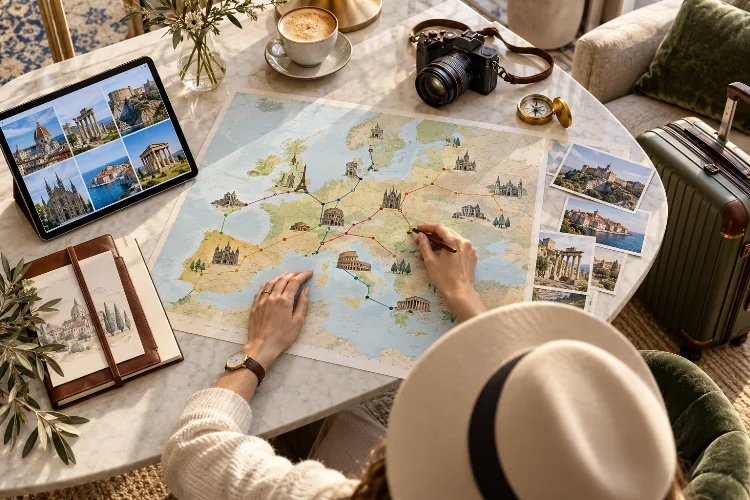
Europe has enough UNESCO World Heritage Sites to make itinerary planning both exciting and slightly overwhelming.
Historic centers, castles, Roman remains, cultural landscapes, industrial complexes, monasteries, and even entire transnational networks can all compete for space on the same trip.
The solution is not to visit as many UNESCO sites as possible. A better approach is to connect places that share geography, history, architecture, or a common cultural story.
Learning how to build European trips around UNESCO World Heritage Sites can transform a normal city-hopping vacation into something much more coherent. Florence becomes more meaningful when combined with Siena and other Tuscan heritage.
Prague can lead naturally into Central European cultural landscapes, while Germany’s Rhine Valley can become a journey through castles, vineyards, historic towns, and river history rather than a single sightseeing stop.
With sensible clustering, slower pacing, and good transportation choices, UNESCO heritage can become the framework for an entire European adventure.
Start With a Theme Instead of a Country List
The easiest mistake is beginning with countries.
You choose Italy, Germany, Austria, Belgium, and Czechia, then search for UNESCO attractions inside each destination. That can create an impressive list but a messy itinerary.
Try reversing the process.
Start with a theme such as Renaissance Europe, medieval trading cities, Roman heritage, royal residences, cultural landscapes, or historic spa towns.
UNESCO itself experimented with this approach through its World Heritage Journeys initiative, which connected 34 European properties through four themes: Ancient Europe, Royal Europe, Romantic Europe, and Underground Europe.
A thematic route gives each stop context.
Instead of thinking, “This is another old building,” you begin seeing how architectural ideas, trade networks, political power, religion, and artistic movements travelled across Europe.
Create Regional UNESCO Clusters
Once you have a theme, group nearby properties geographically.
Italy is one of the easiest places to understand this strategy. UNESCO’s official list includes the historic centers of Rome, Florence, Siena, San Gimignano, Pienza, Naples, and Urbino among many other Italian properties.
Rather than trying to cover the entire country, build a concentrated regional route.
For example:
Florence → Siena → San Gimignano → Pienza
Florence represents one of Europe’s defining Renaissance centers, with UNESCO emphasizing the city’s extraordinary influence on architecture and the arts. Siena offers a very different urban story, retaining a distinctive Gothic character shaped between the 12th and 15th centuries.
These places are close enough to create one cultural journey, yet different enough that the itinerary does not feel repetitive.
This clustering strategy also reduces transport time and unnecessary accomodation changes.
Use Major Sites as Anchors, Not Checkboxes
Some UNESCO destinations deserve several days.
Rome is an obvious example. Its World Heritage property contains layers of ancient, Christian, Renaissance, and Baroque history rather than one monument that can be “completed” in an afternoon.
Florence works similarly.
Instead of scheduling one night simply because the Duomo, Uffizi, and Ponte Vecchio are famous, use the city as an anchor and explore the historical layers around it.
Then add smaller heritage destinations between your anchor cities.
This creates a much healthier rhythm: perhaps four nights in Florence, two in Siena, and another slower Tuscan base instead of changing hotels every morning.
UNESCO-focused travel becomes exhausting when every stop turns into a mission to photograph the official landmark and immediately leave.
Heritage needs time.
Give yourself space to walk neighborhoods, visit smaller museums, eat locally, and see what exists outside the official property boundary.
Include Cultural Landscapes, Not Only Historic Centers
UNESCO heritage is much broader than cathedrals and old towns.
Some of Europe’s most interesting properties combine history with agriculture, geography, settlement patterns, and natural environments.
Austria’s Wachau Cultural Landscape is a great example. The UNESCO property follows the Danube between Melk and Krems and preserves a landscape shaped by monasteries, castles, historic towns, villages, vineyards, and agricultural traditions developed over centuries.
This type of destination works differently from Florence or Prague.
Instead of spending the day moving between museum tickets, you might travel by regional train, boat, bicycle, or a combination of them.
Germany’s Upper Middle Rhine Valley offers another model. UNESCO describes a 65-kilometre landscape between Bingen, Rüdesheim, and Koblenz shaped by historic towns, terraced vineyards, castles, trade, and the Rhine itself.
Adding landscapes like these prevents a heritage itinerary from becoming an endless sequence of stone buildings.
Try a Transnational UNESCO Route
Some of the smartest European heritage trips cross borders because the UNESCO property itself does.
The Great Spa Towns of Europe is an excellent example. This transnational World Heritage property consists of 11 historic spa towns across seven countries: Austria, Belgium, Czechia, France, Germany, Italy, and the United Kingdom.
You obviously do not need to visit all eleven.
A more practical itinerary might focus on Karlovy Vary, Mariánské Lázně, and Františkovy Lázně in Czechia before continuing toward a German spa destination.
Suddenly, crossing a border is not simply moving to another country. You are following the spread of European spa culture, architecture, medicine, recreation, parks, and social life from the 18th century onward.
These shared stories are one reason UNESCO-based travel can be more interesting than conventional country collecting.
Modern borders seperate places that historically influenced each other.
A thematic route puts those connections back together.
Match Transportation to the Heritage Region
Do not assume every UNESCO itinerary requires a rental car.
Many major European heritage cities work exceptionally well with rail. Prague, Vienna, Florence, Rome, Bruges, and numerous German cities can fit naturally into wider train-based routes.
Other areas require a mixed strategy.
For the Rhine Valley, trains and river transport can make more sense than driving every section. For Tuscany, rail works well between major centers, while buses or a car may become more useful when exploring smaller hill towns.
The important thing is to calculate door-to-door travel time, not just distance.
A historic village located only 60 kilometres away can still consume half a day when public transport requires several changes.
Keep those logistical costs in mind before adding another UNESCO property simply because it appears nearby on a map.
Sometimes skipping one difficult stop gives you an extra full day in a place that deserves it.
That is usually a good trade.
Avoid UNESCO Checklist Fatigue
Heritage fatigue is real.
After five medieval old towns in seven days, even magnificent architecture can begin blending together.
Add contrast deliberately.
Follow Florence with a Tuscan landscape. Combine Prague’s architecture with a spa town. Pair an industrial heritage destination with a medieval center or river valley.
Also schedule ordinary experiences.
Visit a market, sit in a café, walk through a residential neigbourhood, explore a contemporary gallery, or spend an afternoon without a heritage objective.
The goal is not to spend every minute learning.
A strong itinerary alternates concentration with relaxation.
You will probably remember three UNESCO sites explored properly far better than eight visited in a rush.
Travel in a Way That Supports Heritage
World Heritage status attracts visitors, which creates both opportunities and pressure.
UNESCO’s Sustainable Tourism Programme emphasizes integrating tourism management with heritage protection, local communities, and responsible destination development. It also recognizes that poorly managed tourism can threaten the very properties travelers come to experience.
Travelers can respond with fairly simple choices.
Stay overnight in smaller heritage towns rather than joining only peak-hour day-trip crowds. Visit during shoulder season when possible, support local guides and businesses, and explore beyond the most photographed street.
Siena, for instance, has faced concerns connected with intense tourism pressure in parts of the year.
Slower travel can therefore improve both your own experience and the relationship between tourism and heritage.
Spending three nights instead of three hours often reveals a completely different place.
Build the Itinerary Before Booking Hotels
Once you have selected your heritage cluster, create the route in layers.
First identify your anchor cities. Then add secondary sites located along the natural transport corridor. Only after that should you decide how many nights belong in each place.
A hypothetical Central European journey might follow:
Prague → Czech spa region → Vienna → Wachau Valley
Prague’s UNESCO-listed historic center reflects architectural development from the medieval period through later Baroque and modern influences. Vienna can provide the major urban base, while the Wachau adds villages, monasteries, vineyards, and river landscapes.
The journey now has progression rather than repetition.
Avoid booking every hotel first and then discovering that the heritage sites create awkward backtracking.
Keep at least one slower day in every week-long section, too.
You may discover a small church, archaeological museum, walking route, or seperate historical district that never appeared in your original research.
That flexibility is part of what makes heritage travel memorable.
Building a European trip around UNESCO World Heritage Sites works best when the list becomes a story rather than a collection challenge.
Choose a historical or cultural theme, create geographic clusters, and use major heritage cities as anchors for smaller destinations and cultural landscapes nearby.
Mix medieval centers with Renaissance cities, river valleys, archaeological areas, industrial heritage, or transnational properties so the trip keeps changing character.
Most importantly, give important places enough time and travel in ways that respect the communities maintaining them.
Before booking your next European itinerary, open UNESCO’s official World Heritage resources and choose three or four properties that genuinely interest you. Then look at what connects them.
That connection – not the number of UNESCO sites you collect – is what can turn a normal European vacation into a journey through history.
